
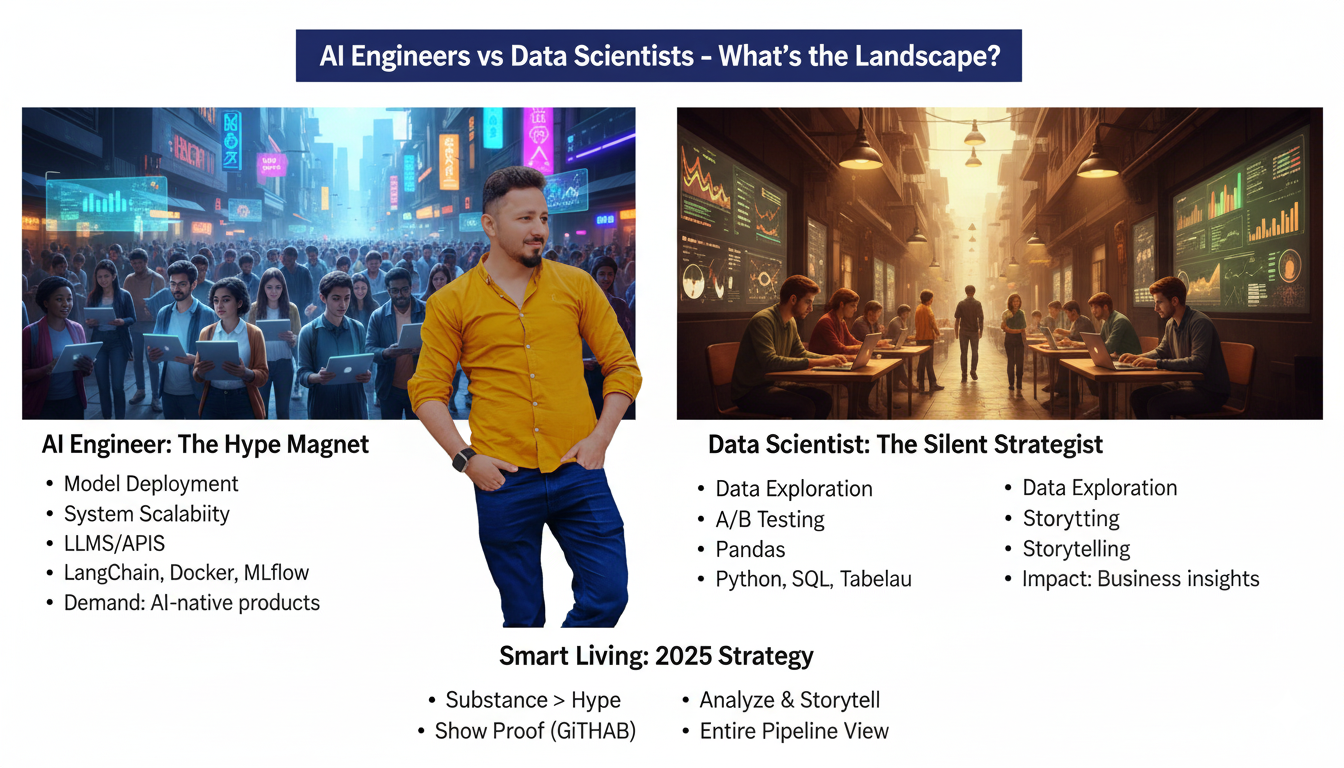
A recent image that is making its way around the internet is a humorous yet realistic representation of the tech industry right now – a bustling street filled with AI Engineers and a much more deserted one for Data Scientists.
It’s funny, sure — but it also represents a real change in how the notion of a hot tech job has changed.
Let’s sort out what’s really going on under the hype — from a professional’s strategic point of view.
AI Engineering is the buzzword of the year; no doubt about it.
With the explosion of Generative AI, LLMs, and low code AI platforms, the need for AI engineers has exploded.
AI Engineers are positioned at the triangle between machine learning, software engineering and deployment. They focus on:
Model deployment and integration
System scalability and optimization
Creating real-world applications using LLMs and APIsTech Stack
Common tools include:
LangChain, OpenAI API, Hugging Face
Vector Databases (Pinecone, FAISS)
Kubernetes, Docker
MLOps tools such as MLflow, Weights & Biases
Why It’s in Demand
Startups and enterprises alike are creating artificial intelligence (AI)-native products and RAG systems and pipelines powered by large language models (LLMs).
This ecosystem generates an unprecedented hiring craze.
But there is a caveat – many are rushing into AI Engineer titles without learning the basics of data. That’s resulting in a pool of individuals who are good at using tools, but not actually good problem solvers.
Data Scientist: The Silent Strategist
While Data Science is the backbone of every intelligent system, it is taking a backseat to AI.
Still Vital, Still Impactful
Data Scientists bring insights, decisions, and measurable business impact by:
Data Exploration and Wrangling
Segmenting and forecasting.
Experimentation and the A/B Testing
Storytelling through data
Beyond Models
It’s never about machine learning models — it is about solving real business problems with data-driven reasoning.
Tech Stack
Their toolkit is still strong and indispensable:
Python, SQL, Pandas, Scikit-learn etc.
Tableau, Power BI, Plotly
StatsModels, Framework for A/B Testing
Cloud Data warehouses (BigQuery, Snowflake, Redshift)
Less Noise, More Substance
Data Scientists might not have the same exposure on LinkedIn feeds as AI Engineers but they are the ones that fuel the insights that dictate strategy.
Those who get the storytelling, causality, and experimentation right without making a big deal out of it deliver the highest ROI.
For Freshers & Working Professionals: Smart Living
The best careers are based on basics, not hype. Whether you are a student, analyst or engineer — here’s how to make smart moves in 2025:
1 Don’t be a hype machine — add substance.
Understand systems, not just the latest tools.
2 You need to know how to analyze data and tell a story first.
Before fine tuning models, learn how to extract insights and communicate them effectively.
3 Show proof of skill.
Projects, Github repos, technical blogs and problem statements are more important than certificates.
4 Gain visibility of the entire pipeline.
From raw data Cleaning analysis modeling deployment impact measurement.
This is the workflow that divides practitioners from professionals.
Please follow us on LinkedIn for latest updates or our website aisohail.com