When handheld calculators first entered schools in the 1970s, parents and educators faced a difficult question: would this device destroy a child’s ability to do math? History tells us that rather than replacing human intelligence, the calculator became a vital aid that handled the drudgery, allowing students to focus on solving more complex problems. Today, we stand at a similar crossroads with classroom technology and Artificial Intelligence.
While many view this technology as simply a smarter search engine, the reality is quite different. A standard Google search retrieves existing links, but AI in the classroom acts more like a creative collaborator or a tireless digital tutor. It doesn’t just find a website; it generates practice quizzes, brainstorms essay topics, or explains difficult concepts in plain English. This shift transforms the computer from a static library archive into an active partner in the learning process.

Ideally, this technology serves to augment the work of human educators, not replace them. In practice, the teacher remains the “pilot,” using these tools to create personalized lessons in minutes rather than hours. By understanding AI as a supportive assistant rather than a substitute for thought, we can move past fear and focus on how it helps students thrive.
From Search Engines to Digital Interns: How AI Generates Rather Than Just Finds
For decades, using technology meant searching for existing information. When you type “Civil War dates” into a search engine, the system acts like a librarian, pointing you toward the right book on the shelf. Generative AI changes this dynamic entirely. It functions less like a retrieval system and more like a well-read digital intern. It doesn’t just find a history essay for you; it writes a new one, word-by-word, based on patterns it has learned from reading millions of documents.
Instead of thinking, the software uses prediction. Much like your smartphone suggests the next word in a text message, AI predicts the next plausible piece of a sentence to create smooth, human-sounding text. However, because the software prioritizes conversational flow over factual precision, it can sometimes be “confident but wrong.” It requires a human pilot to check the work, ensuring that the “digital intern” hasn’t made up facts just to keep the sentence moving.
Controlling this output requires a new skill called “prompting.” Unlike a search bar where you type a few keywords, a prompt is a detailed set of instructions given to the software. It is the difference between asking for “pizza” and ordering a “thin-crust pepperoni with extra cheese and no onions.” As schools adopt various AI education tools, learning to write clear, specific prompts is becoming as important as learning to use a keyboard.
Teachers are already discovering that this ability to generate content is a massive time-saver. By utilizing generative AI for lesson planning, an educator can instantly create three versions of a reading assignment tailored to different skill levels. This capability sets the stage for a major shift in the profession: moving away from late nights spent creating materials and toward a model where automation handles the administrative heavy lifting.
Buying Back Teacher Time: Using Automation to Trade Paperwork for Instruction
If you ask any educator why they entered the profession, few will say they dreamed of managing spreadsheets or drafting newsletters. Yet, administrative duties often consume nearly half of a teacher’s working hours. Reducing teacher administrative workload with automation offers a practical solution to this burnout crisis. It acts as a force multiplier, taking over the repetitive “office work” so educators can return to the “people work” of mentoring students.
This isn’t about replacing the teacher; it is about outsourcing the drudgery. With simple instructions, AI tools can instantly handle tasks that used to take hours of prep time:
- Generating a 10-question multiple-choice quiz based on a specific textbook chapter.
- Drafting clear, polite permission slips for upcoming field trips.
- Creating a weekly lesson schedule formatted for administrative review.
- Composing email responses to common parent questions about upcoming events.
Assessment is another area ripe for support. While a human should always make the final judgment on a student’s performance, automated grading software for essay assessment can provide a “first pass.” These tools can spot grammar errors, check for required structural elements, or offer immediate feedback on clarity. This allows the teacher to focus their energy on the substance of the student’s ideas rather than circling misplaced commas.
Ultimately, the goal of this technology is to buy back time. If an AI assistant saves a teacher five hours of paperwork a week, that is five extra hours available for small-group tutoring or lesson refinement. Once the administrative burden is lifted, the technology creates space for an even more powerful application: acting as a “digital tailor” to customize learning for every single child.
The Digital Tailor: Creating Personalized Learning Paths for Every Student
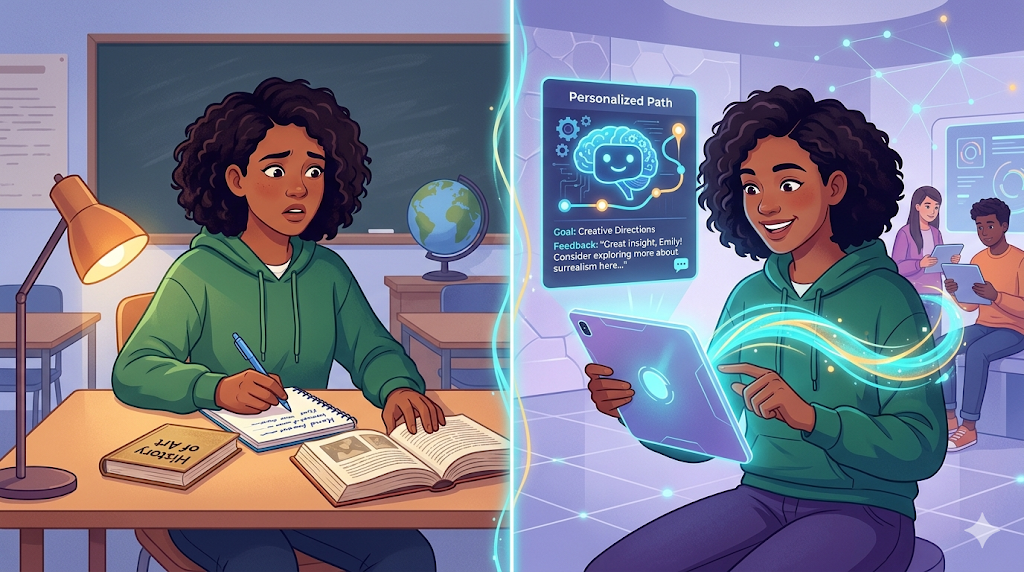
Imagine a clothing store that only sells one size. That is the limitation of a traditional textbook—static and unchangeable. In a diverse classroom, teaching to the “middle” often leaves some students bored and others behind. AI acts as a digital tailor, altering the lesson to fit the individual. A teacher can now generate different versions of the same reading assignment—simplified, standard, and advanced—ensuring everyone learns the core concept at a pace that builds confidence.
This customization scales through adaptive learning platforms for personalized education. Much like a video game that adjusts its difficulty based on player performance, these tools analyze answers in real-time. If a student stumbles, the software doesn’t just mark the answer wrong; it offers hints or reteaches the rule. This creates a safety net that catches confusion immediately, rather than waiting for a failing test grade weeks later.
Technology creates even deeper impact when supporting specific needs. Personalized learning paths for neurodivergent students allow those with dyslexia or ADHD to engage with content in ways that match their processing style. A dense history article can be instantly converted into a bulleted summary or an audio script. By removing formatting friction, the tool ensures a learning difference never becomes a learning barrier.
Yet, introducing such powerful assistants raises valid concerns about over-reliance. Parents and educators naturally worry if “help” might turn into “doing the work for them.” To safely integrate these tools, schools must navigate the complex realities of cheating, accuracy, and student data privacy.
Navigating the Safety Zone: Solving the Dilemmas of Cheating and Inaccuracy
Promoting academic integrity in the era of ChatGPT often feels like a losing battle to many educators and parents. When a student can generate a passable essay in seconds, the traditional take-home assignment seems obsolete. However, simply banning the technology rarely works; instead, progressive schools are shifting toward assignments that require specific personal reflection or in-class defense of ideas. This ensures that while a computer may have helped structure the sentences, the student provided the critical thinking and unique perspective.
Even when students use these tools honestly for research, they face a peculiar technical quirk known as “hallucination.” Generative AI is programmed to predict the next plausible word in a sentence, not to verify facts against a database of truth. It functions like an eager-to-please assistant who would rather invent a convincing answer than admit they don’t know. This can lead to confident-sounding essays that cite books that don’t actually exist or reference historical events that never happened.
Navigating the ethical challenges of artificial intelligence in education requires treating the AI as a draft-generator rather than a final authority. Teachers are now encouraging students to act as “editors,” where the assignment is to generate an AI response and then ruthlessly fact-check it against primary sources. By implementing responsible AI use policies for schools that emphasize verification, educators can transform a potential shortcut into a rigorous exercise in information literacy.
Establishing these safety rails allows classrooms to move past fear and focus on the technology’s ability to bridge vast distances. With the foundational rules of accuracy and honesty in place, AI dissolves the borders of communication for students learning new languages.
The Global Tutor: Breaking Language Barriers with Real-Time Feedback
Learning a new language often feels like performing on a stage where every mistake is public. For English Language Learners (ELL) or students tackling a second language, the fear of mispronouncing a word in front of peers can be paralyzing. AI-assisted language learning applications change this dynamic by offering a private, judgment-free zone. Instead of raising a hand and risking embarrassment, a student can converse with a digital tutor that listens to their pronunciation and suggests improvements instantly, turning a stressful ordeal into a safe practice session.
This technology acts less like a strict exam proctor and more like a tireless conversation partner. It provides what educators call “scaffolding”—support that adapts specifically to the student’s current proficiency level. The benefits of real-time student feedback systems go beyond simple grammar correction; they fundamentally change the psychology of practice:
- Immediate Error Correction: Students fix mistakes the moment they happen, preventing bad habits from forming.
- Low-Stakes Environment: The anxiety of human judgment is removed, encouraging students to speak more freely.
- 24/7 Availability: Personalized help is accessible whenever the student is ready to study, not just during school hours.
When the fear of failure recedes, curiosity has room to grow. Parents and teachers often ask, “Can artificial intelligence improve student engagement?” The answer lies in confidence; when a student feels supported privately, they are more likely to participate publicly in class the next day. Yet, for all its efficiency, the machine remains a navigator, not the captain, leading us to the ultimate necessity of human judgment in the classroom.
The Human in the Pilot’s Seat: Preparing for a Tech-Augmented Future
You no longer need to view artificial intelligence as a mysterious force threatening to replace the human connection in schools. Instead, see it as a powerful engine requiring a skilled pilot. Just as autopilot aids but never replaces the captain, AI handles data processing while teachers provide the essential empathy, mentorship, and wisdom that software cannot replicate. The classroom is evolving, but the heart of education remains deeply human.
To navigate these future trends in educational technology and machine learning, start by testing a simple generative tool yourself to demystify the process. Next, ask your school administrators how they manage data privacy, and advocate for integrating digital literacy into the curriculum. When students learn to guide these tools responsibly, they move from passive users to critical thinkers.
The goal isn’t to compete with machines but to elevate what makes us distinct. By embracing this technology as a partner rather than a rival, we ensure students graduate with the enduring capability to lead in a changing world.