
Artificial intelligence often sounds like science fiction, but it functions more like a tireless, well-read intern. Instead of replacing human logic, this technology acts as a collaborative partner that can completely reshape AI education for curious learners.
Traditional schooling relied on a “one-size-fits-all” model, yet generative AI changes learning by offering a bespoke experience for every student. Education experts note that shifting from passive listening to active, personalized interaction allows these tools to adapt specifically to your unique pace and interests.
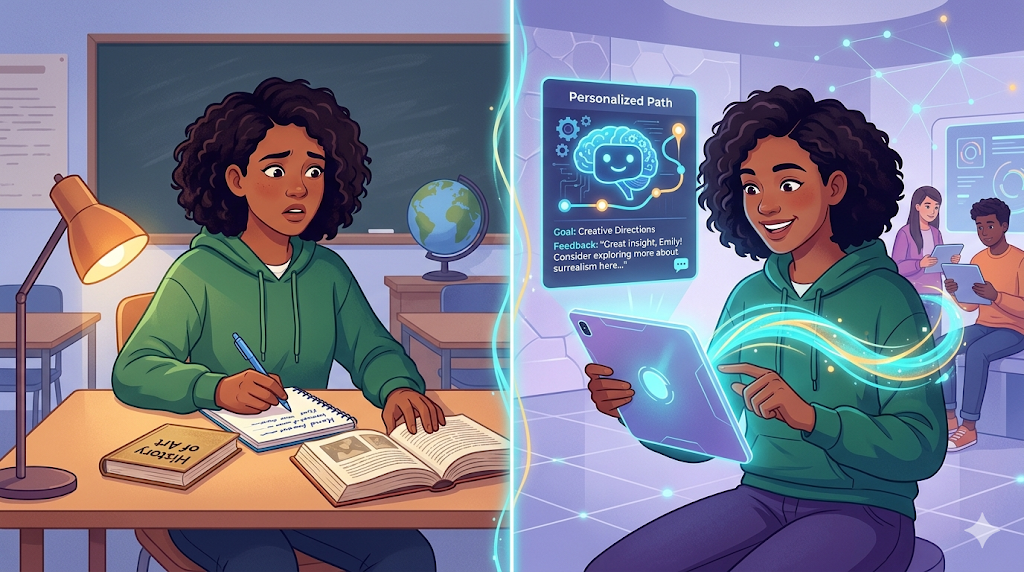
True artificial intelligence literacy for beginners goes beyond just asking a chatbot questions. It involves mastering the right tools, fact-checking results, and navigating ethical boundaries to turn a complex system into a personal tutor for your own growth.
Why Adaptive Learning Beats Traditional Teaching
Remember sitting in math class, bored because you already understood the lesson, or panicked because the teacher moved on before you caught up? That standard approach defines traditional schooling, where everyone turns the page at the same time. Adaptive Learning uses AI to change the difficulty level based on how you answer questions. Think of it less like a static textbook and more like a personal trainer who watches your form, adding weight when you’re strong and lightening the load when you struggle.
These platforms, often called Intelligent Tutoring Systems (ITS), act as 24/7 study buddies that never get frustrated. Because students interact with a computer rather than a person, the anxiety of raising a hand and giving a wrong answer disappears. You can struggle with a concept privately, make mistakes, and receive instant feedback without feeling judged by peers. This psychological safety net encourages learners to keep trying until they truly master the material.
Instead of guessing what you need, the AI follows a continuous loop to map your unique learning path:
- Assessment: It watches how you solve a problem, noting both your speed and accuracy.
- Customization: If you struggle, it offers a hint or an easier question; if you ace it, it skips ahead.
- Delivery: New content is presented exactly when you are ready for it, not just because it’s Tuesday.
- Re-evaluation: The system constantly checks back to ensure you haven’t forgotten previous lessons.
Humans are incredible teachers, but even the best ones can’t track the exact minute-by-minute progress of 30 students simultaneously. An AI system spots specific “holes” in your understanding—like missing a foundational math rule from three years ago—and fills them before moving forward. However, while software is excellent for drills and customized skill-building, it still lacks the empathy and complex mentorship required for deeper emotional development.
Why AI is the Ultimate Teaching Assistant
Most people imagine teaching involves standing at a chalkboard, but the reality often requires hours of unpaid overtime grading papers and drafting emails. AI tools are stepping in to handle this invisible workload, instantly generating detailed rubrics, lesson plans, or parent newsletters in seconds. By automating administrative tasks for teachers, technology gives educators their evenings back so they can focus on connecting with students rather than battling spreadsheets.
Beyond just saving time, these systems act like an early warning radar for the classroom using Predictive Analytics. This technology looks at patterns in attendance and assignment scores to identify students who are likely to struggle weeks before a failing grade ever appears on a report card. Instead of waiting for a midterm disaster, a teacher receives a nudge to intervene immediately, ensuring no child slips through the cracks unnoticed.
Integrating machine learning into curriculum design ultimately shifts the educator’s role from a lecturer who delivers facts to a facilitator who guides growth. This transition allows teachers to prioritize mentorship and emotional support while the software handles the data, though this partnership only works if you know how to catch the AI when it makes a mistake.
Mastering Large Language Models for Research
Think of Large Language Models (LLMs)—the technology behind tools like ChatGPT—not as digital encyclopedias, but as “predictive autocomplete” on steroids. Because these systems are trained to predict the next plausible word in a sentence rather than retrieve hard facts, they can sound incredibly confident even when they are completely wrong. This tendency to invent facts to keep a sentence flowing is often called a “hallucination,” meaning users must shift their mindset from passive reading to active verification.
Democratizing access to specialized knowledge remains the tool’s greatest strength despite these potential errors. You can paste a dense academic abstract into a chatbot and ask for a plain-English summary, effectively turning the AI into a personal translator for complex jargon. However, because how generative AI changes learning relies on this partnership between human judgment and machine speed, you need a safety net to ensure accuracy when using large language models in research.
Adopting a “trust but verify” workflow ensures you get the efficiency of AI without the misinformation. Before accepting any AI-generated claim, apply this three-step check:
- Cross-Reference: Verify specific dates, names, and statistics against a standard search engine.
- Audit Citations: Ask the AI for sources, then confirm those articles actually exist.
- Spot Bias: Look for emotional language that suggests the model is favoring one viewpoint.
Once you master fact-checking, the next challenge is understanding how the data you feed the system might reflect society’s hidden prejudices back at you.
Navigating the ‘Mirror Effect’
If you hold a mirror up to society, it reflects everything—including our prejudices. This “Mirror Effect” explains why AI often produces skewed results. Since models are trained on the open internet, they absorb human stereotypes alongside grammar, making it essential to address algorithmic bias in curriculum and daily research. You aren’t just reading a neutral calculation; you are often seeing a reflection of historical data gaps that favors dominant viewpoints.
Beyond cultural blind spots, the “free” price tag on many tools often costs your privacy. Many platforms analyze user chats to improve their systems, meaning your private drafts or student notes could inadvertently become part of a public model’s training data. To ensure data privacy in educational software, always ask these three questions before using a new tool:
- Does the company claim ownership of the content I generate?
- Is my specific input data used to train the public version of the model?
- Can I request the permanent deletion of my conversation history?
Staying updated on education AI policy news is the best way to track how these companies handle your digital rights. As regulations evolve, your best defense remains personal vigilance regarding what you share. Turning this awareness into a concrete strategy is the essential next step for your career.
Your AI Action Plan
Moving from uncertainty to confidence doesn’t require a technical background; it only takes curiosity. By viewing AI as a helpful collaborator rather than a replacement, you unlock digital fluency for future careers and everyday tasks. The goal isn’t to master every complex detail, but to let these tools handle the heavy lifting so you can focus on creativity and problem-solving.
Your AI education begins with a simple 30-day commitment. Start by testing free vs paid learning platforms to find what fits your needs before investing money. Treat this technology as a ladder for your potential, using small weekly experiments to measure success through time saved and reduced stress.
Start Today:
- Try one adaptive learning platform for ten minutes.
- Practice one research summary using a chatbot.
- Check one policy update regarding data privacy.