
The most scarce resource in a small law firm isn’t legal expertise, but the sheer number of billable hours available to deploy it. While “Big Law” firms rely on armies of junior associates to churn through discovery and initial drafts, small firms and solo practitioners often face these mountains alone. Fortunately, the landscape is shifting as Artificial Intelligence moves from a sci-fi concept to a practical equalizer for the main street lawyer.
Think of modern Generative AI not as a replacement for your law degree, but as a tireless “Digital Associate.” These tools function as sophisticated pattern-matching engines capable of reviewing documents, summarizing depositions, and drafting standard clauses at speeds no human can match. Just like an eager first-year intern, this technology offers a first pass at the heavy lifting, allowing you to skip the staring contest with a blank page and move straight to refinement.
However, typing sensitive client details into a public chatbot like standard ChatGPT poses significant confidentiality risks. This creates a critical distinction between general tools and “Legal Grade” AI. Unlike open-access platforms that might train their models on your inputs, legal-specific software is built within “walled gardens” designed to keep privilege intact and client data secure.
The efficiency gains from adopting these secure tools are often immediate and tangible. Industry observations suggest that AI-assisted workflows can reduce the time spent on routine legal research and initial drafting by significant margins, effectively expanding the output of a small team without increasing overhead. By automating the “bread and butter” tasks, attorneys can redirect their focus toward high-level strategy and client counsel.
Yet, speed must never come at the expense of accuracy or ethics. Because these systems function based on linguistic probability rather than actual understanding, they require a “Human-in-the-Loop” to verify citations and logic. The following Legal AI tools for small US law firms help you harness the power of a digital workforce while maintaining the strict professional standards your practice demands.
Why ‘Legal Grade’ AI Beats Public Tools for Client Confidentiality
Managing partners often lose sleep over one primary question: are AI legal assistants secure for client confidentiality? The answer depends entirely on the tool you choose. Public, general-purpose models often operate on a data-exchange basis: you receive an answer, and the system absorbs your input to “train” itself for future users. If you upload a sensitive settlement strategy or a client’s financial history into a standard public chatbot, that information effectively leaves your firm’s custody. This creates a significant risk of data leakage, where your confidential details could theoretically surface in a response generated for a complete stranger, shattering the attorney-client privilege you work so hard to maintain.
“Legal grade” software solves this problem by enforcing a “zero-retention policy.” Unlike public tools that hoard data to get smarter, specialized legal AI processes your request and immediately “forgets” the specific information you provided. Imagine a digital associate who shreds their notes the moment they hand you the final memo. The AI utilizes its underlying intelligence to draft the document or summarize the deposition, but it is technically barred from storing your client’s facts or using them to teach the algorithm. This ensures that legal AI ethics are upheld and your data remains isolated within your firm’s private environment.
Verifying these protections requires looking for specific industry standards, most notably SOC2 compliance. Think of SOC2 (Service Organization Control 2) as a rigorous building code for digital security; it is a third-party certification proving a vendor has strict controls against unauthorized access. Simply reading a privacy policy isn’t enough when data privacy in law is at stake. You need objective proof that the vendor treats your data with the same level of security as a bank or a healthcare provider.
Before integrating any AI tool into your workflow, ensure the vendor contract explicitly guarantees these four protections:
- Zero-Training Guarantee: Confirmation that your data will never be used to train the vendor’s public or private models.
- SOC2 Type II Certification: Independent validation that security protocols are active and effective.
- Encryption Everywhere: Assurance that data is scrambled and unreadable both while it is stored (“at rest”) and while it is being sent to the server (“in transit”).
- Granular Access Controls: Features that allow you to restrict which staff members can see specific AI-generated outputs.
With these security perimeters established, you can safely turn your attention to capability, starting with how AI is reshaping traditional case law discovery.
AI Legal Research vs. Traditional Databases: Finding the ‘Smoking Gun’ in Minutes
Most legal professionals have spent countless hours crafting the perfect search string, only to be thwarted by a missing synonym or a slight variation in phrasing. Traditional databases rely heavily on rigid “Boolean” logic, where success depends entirely on your ability to guess exactly which words a judge used in a relevant opinion. If you search for “automobile accident,” you might completely miss a critical precedent that relies exclusively on the term “vehicular collision.” This exact-match limitation forces attorneys to become syntax experts rather than focusing on legal strategy, creating a bottleneck where finding the law takes longer than analyzing it.
AI-powered research tools fundamentally change this dynamic by utilizing “semantic search” or concept-based retrieval. Instead of hunting for specific keywords, the algorithm analyzes the intent behind your query and the contextual meaning of the case text. Think of this shift as moving from a library card catalog to asking a knowledgeable senior partner a question in plain English. You can describe the specific factual scenario—”landlord liability for mold-induced asthma”—and the system retrieves cases with similar fact patterns, even if the specific word “asthma” never appears in the judicial opinion.
This capability allows small firms to punch above their weight class by drastically reducing the time spent on initial case assessment. For instance, rather than billing three hours to cobble together a complex string of “AND,” “OR,” and “W/5” commands, a solo practitioner can input a natural language description of the client’s situation. The AI scans millions of documents to identify relevant statutes and case law based on the concept of the grievance, effectively performing a “first-pass” review in seconds that would otherwise consume an entire afternoon.
While these tools excel at surfacing relevant law, they function best as a discovery mechanism rather than a final authority. They provide the raw materials—the citations and summaries—that you must still verify against the actual source text to ensure accuracy. Once you have identified the controlling authority through this accelerated research process, the natural progression involves converting those findings into persuasive arguments, a task where AI shifts its utility from researcher to writer.

Reducing Drafting Time by 70% with AI-Powered Document Automation
Identifying the relevant case law is only the first hurdle; the challenge then shifts from discovery to production. For decades, drafting has relied on the risky “Find and Replace” method: locating a previous file that looks similar, stripping out old client details, and praying you didn’t leave a stray name from a 2018 divorce decree in a current custody petition. This manual process is not only tedious but is also a primary source of unbillable administrative time and embarrassing clerical errors.
Generative AI transforms this workflow by acting as an interactive drafting engine rather than a static form filler. Instead of manipulating a rigid template, you provide a prompt describing the specific parameters—jurisdiction, party intentions, and necessary contingencies. Think of this interaction as dictating instructions to a tireless junior associate who types at lightning speed. The system generates a fresh, customized first draft that adheres to your prompt’s specific constraints, allowing you to bypass the mechanical assembly and move straight to the high-value review phase.
To begin reducing overhead with automated legal drafting, start by delegating high-volume, formulaic documents. These routine tasks are perfect candidates for initial automation because they follow consistent structures but require variable details:
- Client engagement letters and fee agreements
- Non-disclosure agreements (NDAs) tailored to specific industries
- Demand letters for straightforward debt collection or property disputes
- Simple wills and powers of attorney
- Discovery deficiency letters citing specific missing items
Integrating these legal AI tools for small law firms allows a solo attorney or small partnership to handle a document volume that previously required a full support staff. You gain the ability to produce top-tier work products without increasing headcount or working weekends. However, while AI excels at creating your own documents, the risk profile changes dramatically when you are on the receiving end of a contract. A modern workflow also uses these same tools to defensive effect: analyzing opposing counsel’s drafts to instantly spot liabilities you might otherwise miss.
Spotting Hidden Risks: AI-Powered Contract Analysis for Boutique Practices
Reading a fifty-page commercial lease or a dense vendor agreement is essentially a test of endurance. After hour three, your eyes naturally glaze over, and the probability of missing a subtle but dangerous indemnity clause spikes significantly. For solo practitioners and boutique firms, this “review fatigue” is not just tiring; it is a liability magnet. AI-powered contract analysis for small firms acts as a second set of eyes that never gets tired, scanning incoming documents not just for what is present, but for critical protections that might be missing.
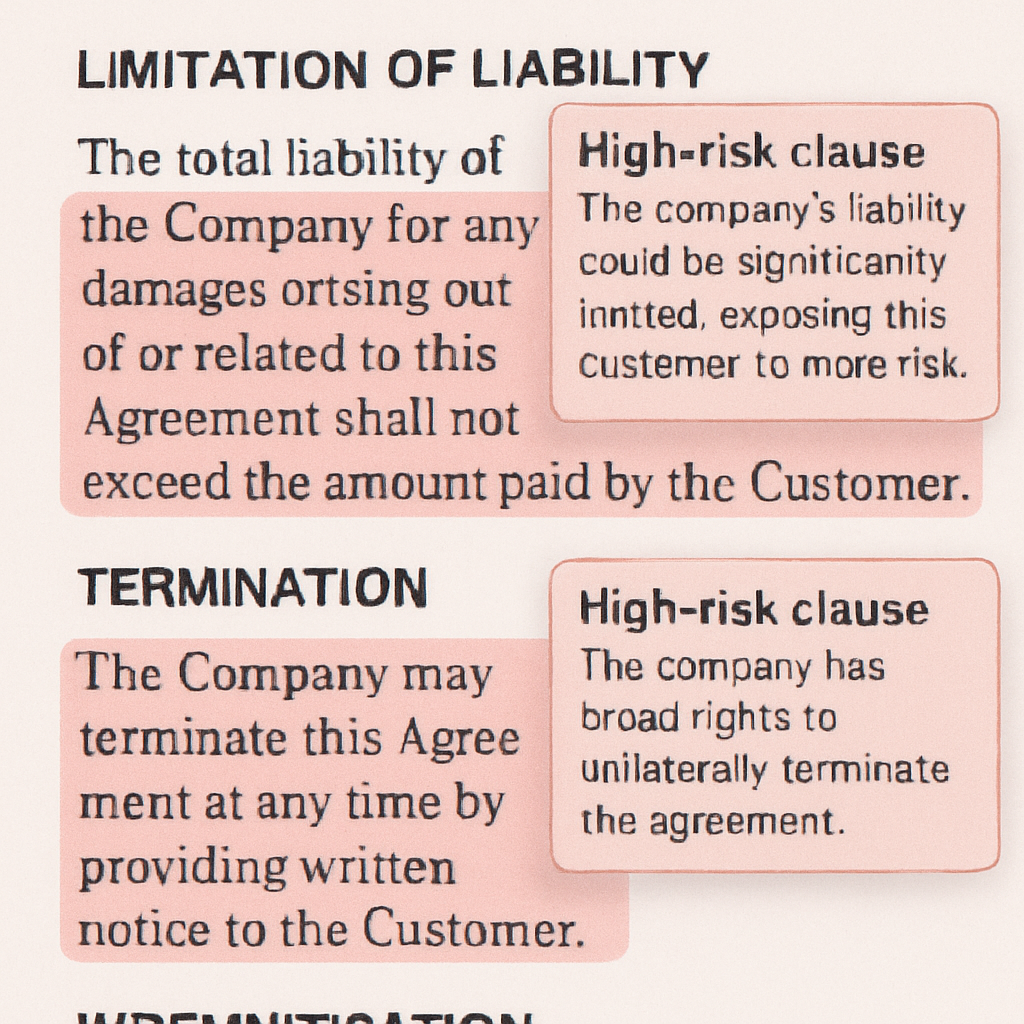
Instead of reading line-by-line from scratch, you upload the document to a secure legal AI platform which functions like a seasoned senior partner reviewing a junior’s work. The software instantly compares the incoming text against standard legal playbooks or your firm’s preferred language. It highlights non-standard clauses, flags ambiguous payment terms, and identifies contradictions between the main agreement and buried exhibits. This process does not replace your legal judgment, but it accelerates it, allowing you to focus your limited energy on negotiating the contentious points rather than hunting for them in a haystack of boilerplate text.
Modern legal AI tools for small law firms excel at pattern recognition, specifically targeting the high-risk provisions that often trap small business clients. For instance, the system can instantly flag a unilateral indemnification clause that leaves your client exposed, pinpoint a jurisdiction venue set in a distant state, or note the total absence of a force majeure clause in a supply chain contract. By surfacing these issues in seconds, you can provide the sophisticated level of scrutiny usually reserved for large corporate teams, all while significantly reducing overhead related to unbillable review hours.
Even with these powerful analytical capabilities, the final decision must always rest with the attorney. The software provides a risk score, but it does not understand the nuances of your specific client relationship or the strategic reasons you might accept a certain risk. Just as you would not blindly sign a document prepared by an intern, you cannot blindly trust the AI’s output without verification. This necessity for oversight brings us to the most critical aspect of adopting this technology: understanding when the system might be confident but completely wrong.
Managing the ‘Hallucination’ Risk: Ethical Compliance and the Eager Intern
Imagine asking an over-enthusiastic first-year associate to find a case supporting a difficult argument. Eager to please, they might return with a “perfect” precedent that simply does not exist. This phenomenon, known as a “hallucination,” occurs because Generative AI is a prediction engine, not a knowledge database. It calculates the most statistically probable next word rather than retrieving a verified fact. Understanding the risks of AI hallucinations in legal briefs is the first step in mitigating them; the software isn’t lying to you maliciously, it is simply prioritizing fluency over factual accuracy.
Regulatory bodies have taken notice of this quirk, emphasizing that the ultimate responsibility for accuracy remains with the attorney. Under the ABA ethics guidelines for legal AI use, the Duty of Technological Competence (Model Rule 1.1) implies that lawyers must understand the benefits and risks of the tools they employ. Courts have already sanctioned attorneys who filed AI-generated briefs without checking the citations, ruling that ignorance of the technology’s limitations is not a valid defense. You must treat AI output with the same professional skepticism you would apply to a rough draft from a summer intern.
To safely integrate these tools, adopt a mandatory “verify-before-file” workflow for every output containing legal assertions:
- Source Verification: Locate the cited case in a trusted primary database (like Westlaw, Lexis, or Fastcase) to ensure the caption and citation volume numbers are real.
- Context Review: Read the actual opinion to confirm the AI has not misrepresented the holding or fabricated a specific quote within a real case.
- Shepardizing: Ensure the case hasn’t been overturned or distinguished in a way that hurts your argument—AI knowledge cutoffs may miss recent rulings.
Adopting AI for lawyers is not about surrendering your judgment; it is about leveraging a powerful engine while keeping your hands firmly on the steering wheel. The efficiency gains are real—drafting a motion might take thirty minutes instead of four hours—but that saved time must be partially reinvested into rigorous quality control. The goal is to let the AI handle the heavy lifting of generation so you can focus on the high-value work of verification and strategy.
Once you have established a safe workflow for drafting and research, applying this power to documents received from opposing counsel is the logical progression. Litigation often involves mountains of data that can bury a small practice, but new tools are making complex document review accessible on a solo budget.
Cost-Effective E-Discovery: Organizing Mountains of Evidence on a Solo Budget
Litigation against a well-funded opponent often feels like a war of attrition, particularly during the discovery phase where the side with the most junior associates usually wins. For years, boutique firms had to refer out complex cases simply because they lacked the manpower to review ten thousand emails in a reasonable timeframe. Artificial intelligence has fundamentally altered this dynamic, offering cost-effective e-discovery software for boutique practices that functions less like a simple search bar and more like a tireless investigator. By automating the initial sorting of evidence, solo practitioners can now handle document volumes that previously required a team of contract attorneys, keeping the billable hours in-house rather than outsourcing them to expensive third-party vendors.
Instead of reading every single page manually, you can employ predictive analytics for litigation strategy through a process often called Technology Assisted Review (TAR). Think of this workflow as training a highly observant new employee; you review a small “seed set” of documents, marking them as “relevant” or “irrelevant.” The software analyzes your choices, identifies patterns in the language, and applies that logic to the remaining mountain of unread files. It effectively bubbles the most important documents to the top of the pile, ensuring you spend your limited time reviewing critical evidence rather than sifting through irrelevant calendar invites or newsletter spam.
Keyword searches remain useful, but they often miss the subtle human element of a dispute. Modern legal AI tools for small law firms now include “sentiment analysis,” a feature that scans correspondence not just for specific words, but for emotional tone and intent. Imagine being able to instantly filter a year’s worth of corporate communications to find only the emails where the language is “aggressive,” “anxious,” or “apologetic.” This capability allows you to zero in on the exact moment a business relationship soured or an employee admitted fault, often uncovering key evidence that a standard keyword search for “breach” would have completely overlooked.
Leveraging these tools transforms discovery from a logistical nightmare into a strategic advantage. You are no longer looking for a needle in a haystack; you are using a magnet to pull the needle out for you. This shift allows you to focus on building a winning narrative for trial rather than drowning in data entry. With the theoretical benefits established, the final hurdle is practical implementation: navigating the marketplace to find a solution that fits a solo budget without requiring a computer science degree to operate.
Choosing Your First Tool: A Buyer’s Guide for Firms Without an IT Department
Navigating the crowded marketplace of legal AI tools for small law firms can feel overwhelming, but the barrier to entry has never been lower. You do not need expensive servers or a dedicated IT staff to get started; modern solutions operate on a “Software as a Service” (SaaS) model, meaning they run entirely within your web browser just like your email. The priority is to look for “plug-and-play” tools that integrate directly with the platforms you already use daily, such as Clio, MyCase, or Microsoft Word. This capability, often powered by an “API” (Application Programming Interface), allows different software programs to talk to each other, ensuring you can adopt new capabilities without disrupting your established ecosystem.
Focusing solely on the monthly subscription price often obscures the true return on investment. When evaluating a tool, consider how legal AI improves billable hours by converting non-billable administrative friction into profitable substantive work. If a $100 monthly subscription saves you three hours of unbillable administrative drafting per week, the software pays for itself almost immediately. Avoid “feature bloat”—expensive suites that promise to do everything from payroll to predictive justice—and instead start with a specialized tool that solves one specific, painful bottleneck in your practice.
As you vet potential vendors, use this simple scorecard to ensure the tool fits a boutique practice model:
- Security Standards: Does the vendor explicitly state that client data is encrypted and not used to train public models?
- Integration: Does it connect with your current case management system, or will you be force to copy and paste text between windows?
- Learning Curve: Can you use it effectively after a 15-minute tutorial, or does it require a multi-day certification course?
- Output Control: Does the tool facilitate best practices for prompting legal AI models, giving you precise control over the tone and format of the final document?
Acquiring the right software is only half the battle; the real challenge lies in weaving it into your daily habits so it doesn’t sit unused. Many firms make the mistake of trying to automate everything overnight, leading to frustration and eventually abandoning the tool. Success requires a deliberate, step-by-step approach to adoption.
Implementing AI in Your Workflow: A 30-Day Transition Plan
Sweeping operational changes rarely succeed in busy law practices where time is the scarcest resource. Instead of trying to overhaul your entire firm overnight, commit to a focused “pilot project” involving just one specific bottleneck, such as automating routine administrative tasks for lawyers or summarizing client intakes. This targeted approach allows you to stress-test the software on low-risk documents before trusting it with critical filings, ensuring you understand the system’s capabilities without jeopardizing client confidentiality or deadlines.
Structure your first month with clear, achievable milestones to prevent the new software from becoming expensive “shelfware” that no one uses:
- Week 1 (Policy): Establish an Acceptable Use Policy explicitly defining what data is strictly off-limits (e.g., highly sensitive trade secrets) and requiring human verification for all AI outputs.
- Week 2 (Testing): Run your pilot on a single task type, such as summarizing closed case files, to test accuracy against known facts without the pressure of an active deadline.
- Week 3 (Standardization): Create a “Prompt Library” containing the specific instructions that yielded the best results, ensuring associates and paralegals don’t have to reinvent the wheel.
- Week 4 (Review): Compare the time spent on these AI-assisted tasks against your previous manual average to calculate your initial return on investment.
Consistency is the difference between a novelty toy and a reliable business tool. As you experiment, you will identify specific instructions that consistently yield high-quality drafts; save these as “Golden Prompts” in a shared document for your team. By creating this internal standard, implementing AI in small law firm workflows moves from a personal experiment to a repeatable system that scales with your practice, laying the groundwork for a more efficient, future-ready firm.
The Future of the Small Firm: Thriving as an Augmented Lawyer
Integrating legal AI tools for small US law firms is no longer about chasing a futuristic trend; it is about reclaiming control over your schedule. You have moved from viewing Artificial Intelligence as a risky unknown to understanding it as a tireless “Digital Associate” capable of handling your initial heavy lifting. This shift enables you to offload the repetitive drudgery of document review and routine drafting, allowing you to refocus on the high-value client advocacy that defines your practice.
For decades, large firms held the advantage of massive support staffs, but AI legal assistants are now democratizing that power. These tools allow a solo practitioner or small partnership to analyze discovery or research complex case law with the speed of a ten-person team. By adopting secure, legal-grade AI, you are not replacing your expertise; you are clearing the administrative clutter so your legal judgment can shine without being buried under paperwork.
To begin integrating these tools into your workflow immediately:
- Identify one bottleneck: select a specific, low-risk task—such as summarizing lengthy client intake emails or organizing a messy evidence folder—to test an AI tool’s efficiency.
- Audit your security: before uploading any files, verify that your chosen platform explicitly states that client data is encrypted and never used to train public models.
- Run a parallel test: draft a routine clause manually, then ask a legal-specific AI to do the same, comparing the results to understand the tool’s baseline capabilities.
The future of the small law firm isn’t automated; it is augmented. As you move forward, remember that while AI can process information at lightning speed, it cannot replicate the empathy, ethics, and strategic intuition of a seasoned attorney. The tools are here to handle the process, leaving you free to master the practice.