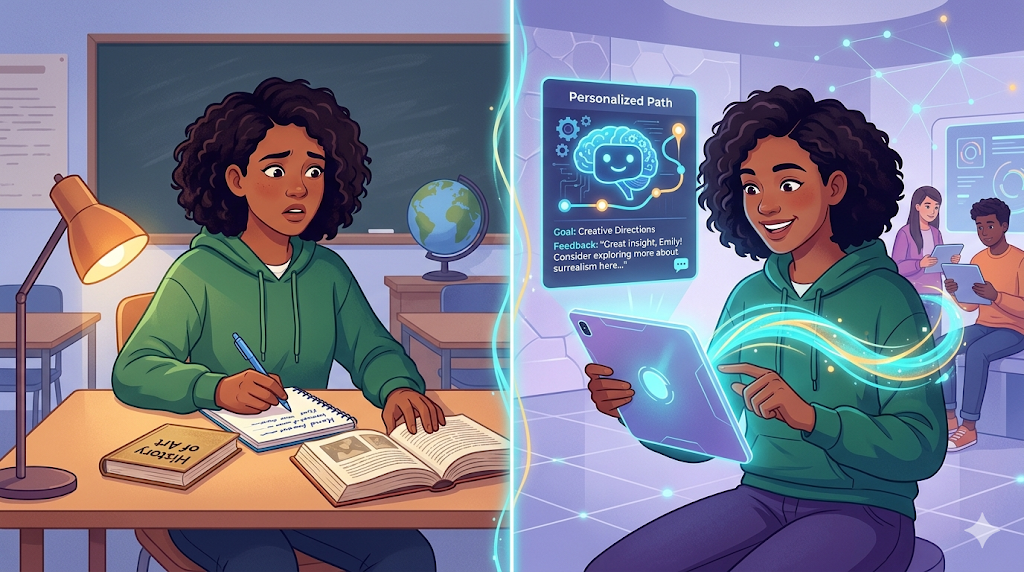

You’ve likely seen the headlines claiming technology will change everything, but when you search for artificial intelligence courses, the sheer volume of options feels paralyzing. It is often like trying to learn a new language while blindfolded—you know you need to start, but you aren’t sure where the starting line is. You aren’t behind; you just need a map to navigate the noise.
Think of AI not as a complex robot, but as a highly trained intern: it handles repetitive tasks so you can focus on the creative, big-picture work. This distinction—knowing how to manage the “intern” versus trying to build it—is the foundation of modern AI literacy. According to recent reports from the World Economic Forum, closing this “AI skills gap” is a top priority for employers, meaning the ability to effectively collaborate with these tools is rapidly becoming as valuable as the technical ability to code them.
Finding the right path starts with defining your personal goal. Whether you are a creative professional wanting to know how to learn generative AI from scratch or a manager seeking better team workflows, the vast marketplace of online ai courses has a specific track for you. Cutting through the hype helps identify the three levels of literacy and create a learning plan that fits your career—no math degree required.
Are Online Artificial Intelligence Certificates Worth It? The Truth About Career ROI
Most people worry that an online certificate is just a digital piece of paper, but the modern job market is rapidly shifting toward skill-based hiring—where your ability to perform specific tasks outweighs university prestige. The question of are online artificial intelligence certificates worth it comes down to Credential ROI (Return on Investment)—basically, whether the potential salary bump justifies the cost and effort. Major tech giants like Google and IBM now treat specific professional certificates as equivalent to college degrees for entry-level roles, validating this new educational path for non-traditional learners.
Differentiating between career-changing education and “filler” content is crucial because not all digital badges carry equal weight. The most valuable artificial intelligence and machine learning courses require you to build a portfolio of projects—like creating a basic chatbot—rather than just watching videos. Industry-recognized platforms like Coursera or edX generally offer the highest quality control. If you are seeking the best machine learning certifications for beginners, prioritize programs that force you to work with real data, as hiring managers want proof of competence, not just attendance.
Speed is another significant benefit, with many learners seeing results in as little as three to six months of part-time study. This rapid “time-to-value” lets you pivot careers without quitting your current job, provided you select a curriculum that aligns with your technical tolerance. Since options range from broad overviews to intense math-heavy bootcamps, you must next understand the specific distinctions between the different types of AI technologies to choose the right lane.
Choosing Your Starting Point: Identifying the Differences in AI vs. ML vs. DL Syllabuses
Navigating course catalogs often feels like reading a foreign menu because terms like “AI,” “Machine Learning,” and “Deep Learning” are frequently used interchangeably, despite representing vastly different skill sets. Consider Artificial Intelligence as the broad concept of “transportation,” while Machine Learning is a specific category like “cars,” and Deep Learning represents high-performance “Formula 1 race cars.”
A general AI course covers the history and ethics of smart systems, whereas a machine learning vs deep learning syllabus comparison reveals that ML classes focus on teaching computers to learn from data—like predicting house prices based on square footage. In contrast, Deep Learning dives into complex, brain-inspired layers used for heavy lifting, such as recognizing faces or translating languages in real-time.
Recognizing these distinctions allows you to align the curriculum with your specific professional ambitions rather than wasting time on irrelevant technicalities. If you are trying to decide which “vehicle” you need to learn how to drive, look for these key indicators in the syllabus:
- Artificial Intelligence (General): Focuses on logic, rules, and automation; best for project managers and business leaders.
- Machine Learning (ML): Centers on statistical patterns and algorithms; ideal for data analysts wanting to predict business trends.
- Deep Learning (DL): Involves multi-layered “Neural Networks”; required for engineers building self-driving cars or advanced chatbots.
Choosing the advanced track offers high rewards, but it creates a steep learning curve that demands a stronger foundation in mathematics. Career paths after completing neural networks training often lead to specialized roles in robotics, but be warned: these courses usually require a working knowledge of calculus and linear algebra. Similarly, industry-recognized computer vision certifications—which teach machines to “see” and interpret images—are math-heavy because they essentially translate pixels into complex grids of numbers. If the prospect of advanced equations makes you hesitate, don’t worry; there is a booming sector of the industry that bypasses the heavy coding entirely.
The ‘No-Math’ Entry Point: How to Learn Generative AI From Scratch Without Coding
If the prospect of calculus makes you hesitate, the modern technology landscape has shifted in your favor. While engineers build the engines, a new wave of professionals is simply learning how to drive them using Generative AI. This technology acts like a highly trained digital assistant that creates content based on plain English instructions rather than complex code. Examining how to learn generative AI from scratch reveals that the curriculum focuses on clear communication and logic rather than algebra, making it the perfect entry point for non-technical learners.
Success in this field relies on Prompt Engineering, which is the art of asking precise questions to get high-quality answers. You are interacting with Large Language Models (LLMs)—vast systems trained on internet text to recognize patterns—and your prompts are the keys that unlock specific information. While advanced natural language processing specialization modules explore the complex science of how machines understand grammar, general courses teach you how to structure requests to turn a basic chatbot into a reliable business partner.
Becoming a power user requires understanding the limitations and capabilities of these tools to solve real workplace problems. Most introductory artificial intelligence courses now prioritize this “human-in-the-loop” approach, proving that your ability to guide the AI is just as valuable as the ability to build it. However, if you eventually decide you want to look under the hood and customize these tools further, you will need a specific set of technical keys.
Essential Python Libraries for AI Students: The Only Tools You Need to Start
Crossing the bridge from simply using AI to actually building it begins with Python, the industry-standard programming language. Fortunately, developers rarely write code from scratch; instead, they rely on pre-written code bundles called libraries. Understanding these essential Python libraries for AI students is like having a fully stocked utility belt before you step onto a construction site, allowing you to focus on solving problems rather than reinventing the wheel.
Most online ai courses introduce these four pillars early in the curriculum because they handle the heavy lifting of data organization:
- NumPy: The calculator that handles complex math equations instantly.
- Pandas: The organizer that sorts and cleans data like a hyper-powered Excel spreadsheet.
- Matplotlib: The artist that converts raw numbers into visual charts and graphs.
- Scikit-learn: The toolkit that contains the actual algorithms used for predictions.

Mastering these specific tools is often more valuable than memorizing every rule of the language itself. In a typical machine learning vs deep learning syllabus comparison, these libraries appear in both tracks because manipulating data is the universal first step for any project. Once you are comfortable with these basics, the only remaining challenge is deciding which learning environment—a structured degree or a flexible bootcamp—best fits your life.
Comparing the Big Three: University Programs vs. Self-Paced Online Learning
Weighing university programs vs self-paced online learning often feels like choosing between a Michelin-star culinary school and a focused cooking masterclass; one offers deep prestige and theory, while the other teaches you to make a specific meal tonight. Formal academic degrees excel at teaching the underlying “why” of artificial intelligence, making them ideal for those wanting to invent new technologies, but they require a heavy time investment. Conversely, online certificates focus entirely on the “how,” allowing you to build a portfolio of functional projects quickly to prove your skills to employers who increasingly value capability over credentials.
Tuition costs often scare learners away from formal credentials, but the barrier to entry is lower than many assume. You can frequently find significant financial aid for artificial intelligence masters programs when they are delivered through online partnerships with platforms like Coursera or edX. This hybrid approach allows you to access the rigorous curriculum of a top-tier university without the massive overhead of on-campus living expenses, effectively democratizing access to elite education.
Academic rigor does come with a catch regarding your background knowledge. The prerequisites for enrolling in an AI degree are almost always stricter than casual courses, typically demanding college-level calculus and linear algebra before you even read the syllabus. If dusting off old math textbooks feels like a roadblock rather than a stepping stone, looking toward an immersive training program that bundles foundational skills with career support might be a smarter strategic move.
Top-Rated Data Science Bootcamps with Job Placement: What to Look for Before You Pay
If university degrees feel too slow and self-paced videos feel too lonely, bootcamps offer a “personal trainer” approach to your career change. These immersive programs promise to take you from novice to job-ready in months, filling the gap between casual artificial intelligence and machine learning courses and multi-year degrees. However, because tuition can rival the cost of a used car, you need to look beyond flashy marketing claims. The most critical metric isn’t the syllabus—it’s whether their graduates actually get hired.
Distinguishing a genuine career launchpad from an expensive tutorial series requires investigating the school’s industry connections. Many programs offer “career coaching,” which often just means resume reviews, whereas top-rated data science bootcamps with job placement guarantees maintain active relationships with companies looking to recruit. A true hiring partner is like a fast-pass lane at a theme park; they bypass the standard application pile to get your portfolio directly in front of hiring managers. Always ask for an outcome report audited by a third party (like CIRR) rather than relying on the school’s own self-reported “99% success” statistics.
Before signing an enrollment agreement, treat the admissions interview like an interrogation to protect your investment. Even the best machine learning certifications for beginners should stand up to scrutiny regarding their return on investment. Use this vetting checklist to cut through the sales pitch:
- Audit Check: Does an independent agency verify your job placement rates?
- Success Definition: Do you count part-time or contract roles as “successful placements”?
- Live vs. Recorded: What percentage of the curriculum is live instruction versus pre-recorded video?
- Alumni Access: Can I speak to a graduate who finished the program six months ago?
- Partner Quality: What defines a “hiring partner”—a guaranteed interview or just a job board listing?
Once you have verified the school’s reputation, your focus must shift to the work you will actually produce, specifically how to turn classroom assignments into a professional portfolio.
Beyond the Lessons: Developing a Professional Portfolio Through Capstone Projects
Completing even the most prestigious online ai courses provides you with knowledge, but employers need proof that you can apply it outside a classroom. Think of a certificate as a learner’s permit; it proves you know the rules, but it doesn’t demonstrate that you can drive in heavy traffic. This is the function of a capstone project, which acts as a practical road test where you solve a messy, real-world problem. By moving beyond polished textbook exercises, you show hiring managers that you can navigate the unpredictability of actual data to deliver a working solution.
Your strategy for developing a professional portfolio through capstone projects should leverage your specific industry background to create a unique advantage. Instead of building a generic image generator, a marketing professional might create a tool that analyzes customer sentiment in email subject lines. This approach proves you understand how to translate technical concepts into specific business value. When you save your work on GitHub—a digital library where developers store and share code—always write a clear, jargon-free summary so a non-technical recruiter can understand your solution without needing to be a programmer.
A strategic portfolio effectively bridges the gap for career changers facing the “experience required” barrier on job applications. It serves as tangible evidence of your capability, validating your transition into career paths after completing neural networks training or foundation model coursework. With your practical skills verified and your project library built, you are now ready to map out the specific milestones for your professional transition.
Your Step-by-Step Roadmap to Become an AI Engineer from Any Background
The landscape of artificial intelligence courses often looks like a chaotic jungle of buzzwords, but you now possess the compass to navigate it with confidence. You have moved past the initial intimidation and realized that AI literacy is not reserved for mathematicians or data scientists. The path ahead is no longer a mystery, but a series of manageable steps designed to fit your unique career goals.
Visualizing your next year involves a clear step-by-step roadmap to become an AI engineer or simply a proficient user. The first few month’s act as your literacy phase, where you learn to speak the language and use tools effectively. As you progress into the Foundation stage, you will peel back the layers to understand how these models think, transforming from a passive observer into an active creator who understands the mechanics behind the magic.

As you deepen your technical skills during the Specialization phase, remember that power requires responsibility. A robust AI ethics and safety curriculum overview is not just an optional add-on; it is the guardrail that ensures your innovations help rather than harm. Understanding bias, privacy, and safety is just as important as learning code, distinguishing true professionals from mere technicians.
Your twelve-month journey begins with a single, small action taken today. Commit to enrolling in just one introductory course or watching a foundational tutorial to break the inertia. The future of technology is moving fast, but with this roadmap in hand, you are fully equipped to walk alongside it rather than trail behind.