We’ve all witnessed the classic classroom dilemma: half the students race ahead while the others stare blankly at page one. For a single teacher managing thirty different minds, this creates a frustrating feedback gap where the “silent struggler” inevitably loses interest and falls behind. Educational surveys consistently reveal that teachers desperately want to help every child, but simply lack the hours to provide constant individual attention.
Rather than replacing educators, modern software acts as a vital co-pilot. Integrating AI tools for student engagement gives teachers a digital force multiplier that extends their reach to every desk. Interactive learning platforms with artificial intelligence don’t take over the room; they handle routine hurdles so humans can focus on genuine mentorship.
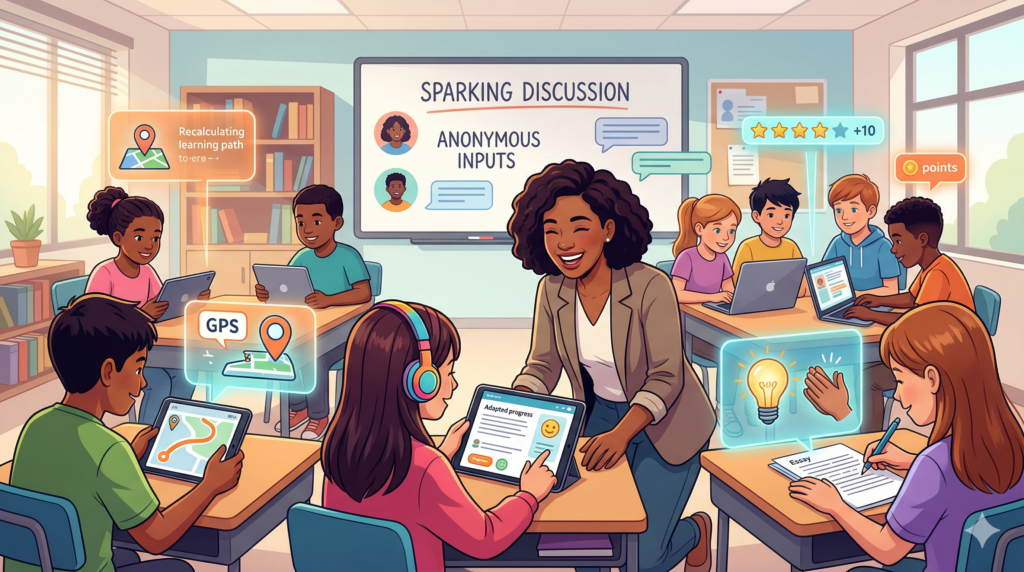
Think of this shift like using a navigation app on a road trip. Solving low student participation with adaptive technology works exactly like a GPS that instantly recalculates a route when a learner takes a wrong turn. It meets children exactly where their knowledge ends, safely guiding them forward without frustration.
Beyond the “Robot” Myth: Understanding AI as a Smart Digital Assistant
Hollywood movies often picture robots running classrooms, but the reality is much less dramatic. Think of generative AI not as an independent, thinking machine, but as a highly advanced filing cabinet. This software relies on large language models—smart digital libraries that have read millions of books—to instantly summarize facts or organize student notes.
Discovering the practical benefits of using large language models in pedagogy requires shifting from simply using the tool to truly learning alongside it. This introduces a powerful method called co-creation, where a student acts as the creative director and the AI serves as their digital sketchpad. The student provides the original ideas, while the tool helps draft the outline.
Throughout this collaborative process, the human teacher remains the essential supervisor who guides the lesson and verifies the work. Because the technology handles basic organization, educators finally gain time to focus on individual needs. This exact time-saving partnership can also provide instant feedback that keeps students motivated.
Stop the Grading Lag: Using AI for Instant Feedback
Handing in a math worksheet and waiting days to find out the results often kills a student’s momentum. By introducing personalized feedback automation for teachers, schools are finally changing this frustrating dynamic. Instead of merely marking answers wrong days after the fact, these digital tools offer gentle, immediate hints the moment a child gets stuck on a problem.
Catching those missteps instantly doesn’t just improve academic accuracy; it actively builds lifelong confidence. If a student is drafting a history essay, the AI can recognize their specific writing style and offer customized encouragement, perhaps suggesting stronger vocabulary rather than rewriting their sentences. This immediate, highly tailored loop keeps their creative spark alive and dramatically improves how well they remember the material.
Behind the scenes, educators benefit just as much from this technology. Using real-time analytics for monitoring student progress, a teacher’s dashboard acts like an early-warning system, highlighting exactly who needs human intervention before the period ends. With the grading lag conquered, classrooms can naturally transition to creating more durable, engaging learning experiences.
Making Learning Stick: Gamified Tools That Adapt to Every Student’s Pace
Watching a student stare blankly at a stack of flashcards reveals a common instructional flaw: they are either bored by easy words or frustrated by hard ones. Modern adaptive technology acts like a personalized digital tutor, constantly adjusting the challenge so the child stays in that perfect “Goldilocks zone.” Instead of rote memorization, AI transforms studying into an engaging quest.
This shift from chore to play relies on three features of effective gamified AI tools:
- Adaptive difficulty leveling, preventing boredom by automatically increasing the challenge as a student masters a skill.
- Spaced repetition, which introduces a tricky concept right before the brain forgets it—a proven method for improving information retention.
- Immediate progress rewards, offering powerful psychological boosts when students succeed.
Today, these mechanics power everything from elementary math games to gamified assessment tools for higher education. Experiencing this constant, gentle adjustment builds tremendous confidence, laying the groundwork for more inclusive instruction.
Levelling the Playing Field: How AI Supports Neurodivergent Learners
Imagine being the only student handed a visibly “easier” worksheet while your friends dive into the main textbook. It quickly crushes a child’s confidence. Today, AI provides a new approach to differentiated instruction that happens entirely behind the scenes. This stealth support allows students to tackle the exact same subjects as their classmates without feeling singled out or embarrassed.
When a bright child with dyslexia struggles with a dense history article, frustration naturally builds. Using text simplification, an AI assistant instantly rewrites the passage with accessible vocabulary while preserving the core facts. These inclusive education tools for neurodivergent learners ensure that a temporary reading challenge never permanently derails a student’s grasp of the actual curriculum.
Assistive AI similarly empowers those who find physical handwriting difficult or distracting due to ADHD. By simply speaking their thoughts aloud, voice-to-text features allow their brilliant ideas to flow directly onto the screen. Giving every child the personalized tools they need to express themselves builds a foundation for genuinely inclusive classroom dialogue.
From Silence to Spark: Sparking Inclusive Classroom Discussions
In many classroom debates, the same three confident students tend to dominate the room. To break this familiar cycle, educators are enhancing student collaboration through smart whiteboards that let shy learners type their thoughts anonymously from their desks. This simple shift creates a safe environment where a thoughtful idea matters far more than a loud voice.
Once these initial thoughts appear on the screen, the technology steps in as a helpful perspective generator. If a class is stuck on a single viewpoint, the teacher can ask the tool to instantly provide three opposing arguments. It acts as a friendly digital devil’s advocate, challenging students to think critically and defend their answers without anyone feeling personally attacked.
Throughout the lesson, the intelligent dashboard quietly tracks participation trends to ensure every student’s unique voice is recognized. Instead of constantly tallying who hasn’t spoken up, teachers can rely on this subtle guidance to balance the room. Relinquishing this mental checklist naturally clears the path for deeper student connections.
More Human Time: Reducing Administrative Tasks
Teachers often spend more hours managing paperwork than actually mentoring their students. By shifting routine administrative duties to a digital assistant, educators reclaim precious hours for the human connections that matter most. When AI handles the heavy lifting of data entry and formatting, a teacher is suddenly free to pull up a chair next to a struggling student and offer personalized emotional support.
This shift from clipboards to people happens through a few practical tools. Three ways educators are actively saving time include:
- Generating three versions of one lesson (easy, medium, and hard) in under two minutes via AI-powered lesson planning.
- Building fair, customized scoring guides through automated rubric generation.
- Drafting fast, professional email updates to keep parents informed.
Naturally, parents might worry about a machine evaluating their child’s hard work. However, reducing teacher workload with automated grading assistants doesn’t mean a computer decides the final grade; it simply provides a helpful starting point. With these daily tasks streamlined, schools can confidently turn their attention to maintaining strict security and privacy standards.
The Safety First Approach: Keeping Students Secure
Protecting student privacy is the absolute priority when introducing new technology. The safest educational tools act like secure digital sketchpads, helping kids brainstorm without ever collecting names or personal details. Establishing these firm data boundaries forms the foundation of any ethical implementation of AI in the classroom.
Software is never left to run the show alone, however. Educators follow a strict safeguard: keeping a human in the loop. This means an adult always reviews and approves what the technology suggests before a child relies on it, guaranteeing the information is accurate, appropriate, and genuinely helpful.
This active supervision shifts the focus from finding quick answers to understanding the learning process itself. By treating technology as a co-creator rather than a shortcut, kids learn alongside it instead of simply cheating. With these protections securely established, educators can confidently implement these tools in their daily routines.
Your First Step Toward a Smarter Classroom
Rather than fearing a robotic takeover, educators can view AI tools for student engagement as a vibrant new set of crayons in their educational toolbox. They won’t magically solve every hurdle, but they do spark genuine curiosity and free up valuable time.
Start with a manageable routine: pick a single subject, explore free educational software for interactive lectures, and test it alongside your students. Evaluate the choice by ensuring it protects data, encourages critical thinking, and adds clear instructional value. By adopting this practical approach, you prepare students for tomorrow’s reality while keeping the classroom centered on inspiring, human connection.