Accuracy
AI in Medical Diagnosis: Simple and Clear
Why AI Matters in Healthcare
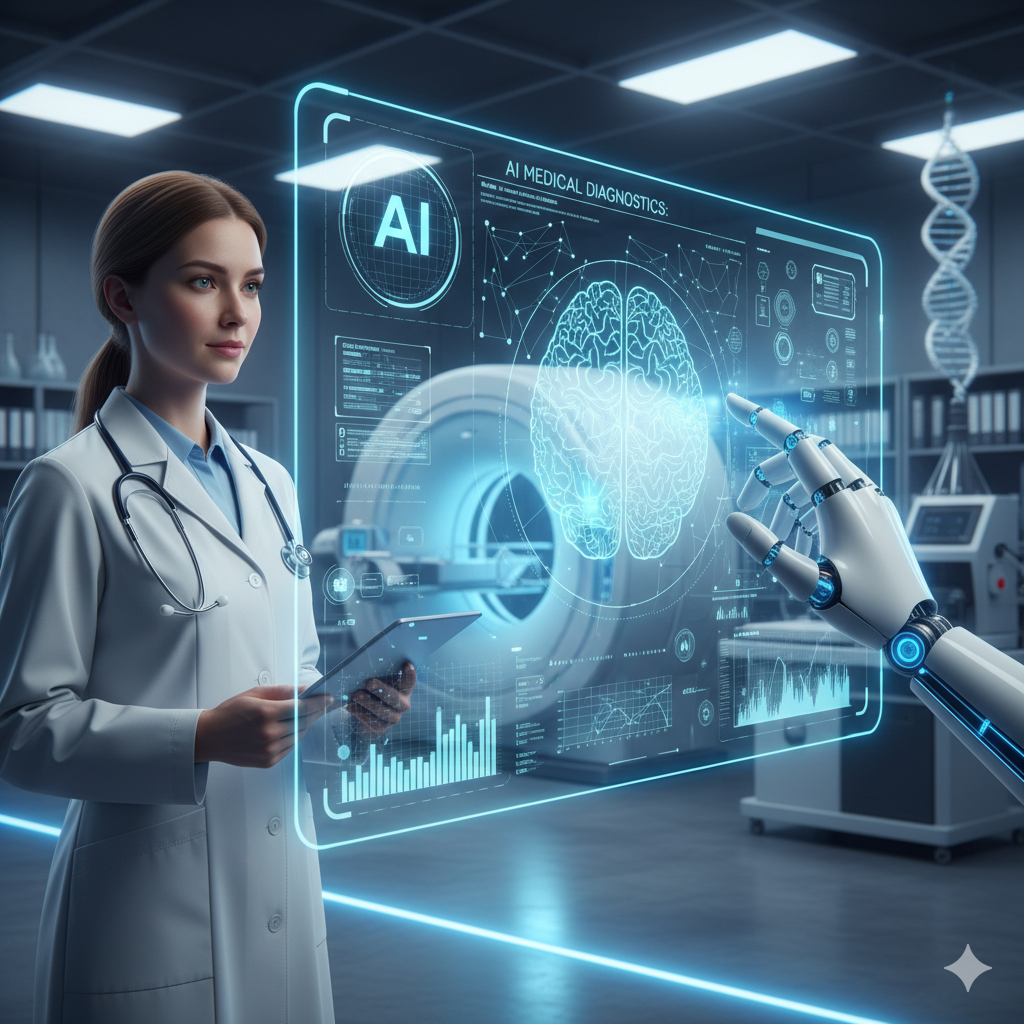
Artificial intelligence (AI) is changing medicine. It helps doctors find diseases faster and more accurately. For example, AI can detect early signs of cancer and review brain scans with speed. As a result, doctors can make better decisions and improve patient care.
From Old Methods to Smarter Systems
Human Skills vs. Machine Power
In the past, doctors relied only on their own skills. This worked, but it also had limits. However, AI can study huge amounts of data in seconds. Therefore, it often gives results that are more precise than traditional methods.
How AI Improves Medical Imaging
AI is especially strong in medical imaging. It reviews X-rays, MRIs, and CT scans. For example, it can notice tumors or fractures that humans may miss. In addition, many radiologists now use AI as a second opinion. As a result, diagnoses are safer and more reliable.
Key Uses of AI in Diagnosis
Detecting Cancer Early
AI checks biopsy samples, mammograms, and blood tests. In many cases, it finds breast, lung, and skin cancer at early stages. More importantly, AI also helps design treatment plans that match a patient’s needs.
Supporting Heart Care
AI tools can read ECG results and find heart rhythm problems. In addition, smart wearables track the heart in real time. As a result, doctors can act quickly during emergencies.
Helping with Brain Health
AI supports neurologists by reviewing scans and records. For example, it can detect Alzheimer’s and Parkinson’s before serious symptoms appear. This allows treatment to begin sooner.
Faster and Wider Access to Diagnosis
Quick Help for Doctors
AI speeds up the process. Instead of waiting days, doctors can get insights within minutes. For example, during a visit, AI can suggest possible conditions. This makes decisions faster and more accurate.
Reaching Remote Areas
AI is also useful in rural regions. For instance, portable AI tools can test for diabetes, infections, or eye problems. In addition, local health workers can use these tools without needing a specialist nearby.
Why AI Works Well
Learning from Data
AI does not guess. Instead, it learns from large sets of medical records. The more data it sees, the smarter it becomes.
Preventing Illness
In addition to diagnosis, AI predicts risks. For example, it can warn patients about diabetes or high blood pressure based on lifestyle and test results. As a result, care shifts from treatment to prevention.
Challenges and Concerns
Can AI Replace Doctors?
AI is fast, but it cannot replace human doctors. However, it works well as a partner. Doctors still provide empathy, judgment, and care.
Data Privacy
AI needs access to patient records. Therefore, strong security and clear consent are very important.
Avoiding Bias
Sometimes AI reflects bias from the data it learns. For example, if data lacks diversity, results may be unfair. In addition, developers must train AI on a wide range of cases.
Real-Life Examples
- Mayo Clinic: AI finds cancer cells in slides more precisely.
- Google DeepMind: AI can detect over 50 eye diseases from retinal scans.
What the Future Holds
Smarter Wearables
Wearable devices will keep tracking health nonstop. As a result, AI will warn patients and doctors before problems get worse.
Personalized Care
AI will combine medical history, lifestyle, and genetics. In addition, it will create treatment plans tailored to each person.
Chat and Voice Tools
Soon, patients may use AI chatbots or voice tools for first checks. For example, they could describe symptoms, and AI would suggest next steps.
Final Thoughts
AI in diagnosis is not just a trend. Instead, it is a real change in healthcare. It makes results faster, clearer, and easier to access.
However, human doctors remain central. AI analyzes data, but people bring care and trust. Finally, the future of medicine looks strong with AI and doctors working side by side.