
AI is transforming the learning process and the work process, though not equally fast. Whereas the education system is starting to embrace AI-powered instruments, the employment sector has already gone a step further. The outcome is seen in every corner: freshly graduated students who cannot find any good job, and parents who refuse to accept that schools are actually preparing children to the future.
The core drivers of employability and long-term career development consist of a handful of human perennial: creativity, people-handling skills, judgment, and the capacity to draw connection between dots so as to make decisions, and a high level of responsibility. The painful question is, how many of these are really imbibed in school?
Traditional education has fared well as regards to imparting knowledge and recalling it. It has not been as successful in cultivating judgment, decision-making or accountability. There are group projects, but it is not common to find real ownership. It is theory based on the promotion of creativity and limited by the standardized tests. People skills are presumed to be developed and not taught. And these are the exact skills that employers appreciate the most- particularly in an AI-driven world.
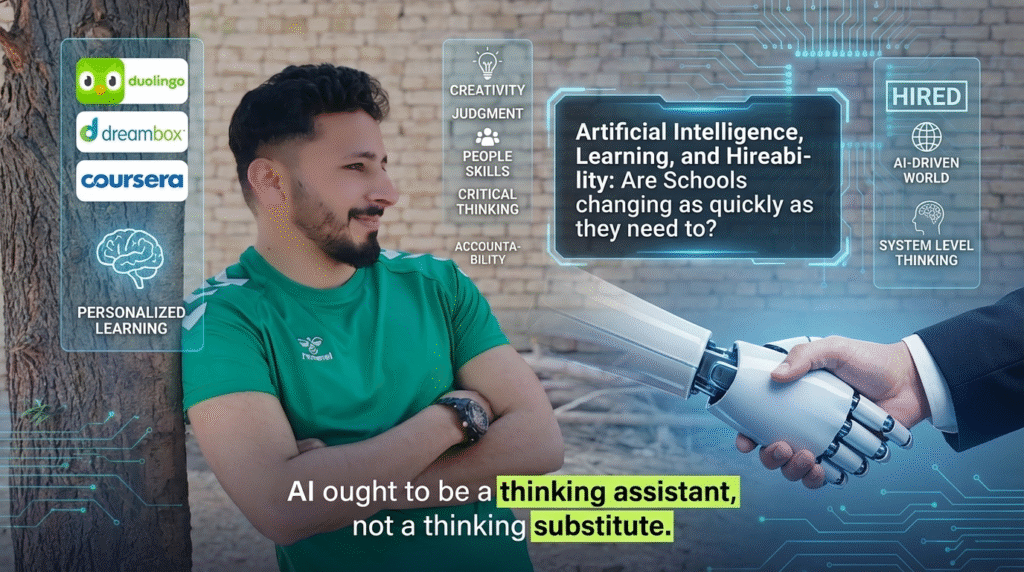
Learning is undergoing change already by AI. Languages such as Duolingo are personalized. DreamBox modifies lessons in real time. Grammarly is an instant writing feedback. Coursera makes the best access to global education. These tools aid the students to learn at a faster rate, detecting gaps and practice on their own. This is a huge step forward as far as efficiency is concerned.
Nevertheless, the employment sector requires something much more than individual tutoring.
Employers do not hire individuals to do a job anymore, they are hiring individuals that will be able to work alongside AI to achieve their outputs many times over. The skill shift is clear. The position of data entry and manual review is giving place to the analytical judgment and interpretation of AI-generated data. The simple coding is being complemented, or substituted by the timely engineering and system level thinking. The ability to know what to request, what to verify, and when to have AI over-rule is becoming more significant than carrying out the instructions.
This is where education will be left out.
Unless the students receive training on how to use AI as a shortcut in order to write essays, solve problems, or create answers, they can get dependent instead of empowered. The actual potential is educating the students on how AI functions, where it is really failing, how it is biased, and how human judgment is always involved. AI ought to be a thinking assistant, not a thinking substitute.
The schools and colleges then need to orient towards two simultaneous objectives. To begin with, develop good fundamentals: literacy, numeracy, scientific reasoning and domain knowledge. In the absence of the above, AI outputs cannot be judged or criticized. Second, explicitly build the skills in higher level: critical thinking, ethical reasoning, teamwork, making decisions in the smacky, and outcome responsibility.
Visualize the classrooms where AI could be used by students to analyze real-world issues, discuss trade-offs, justify decisions and reflect on errors. And where examinations do not favor memorization. Where teamwork, communication, and responsibility are not assumed but evaluated.
The discussion on whether AI in education is good or bad is not the point. AI is inevitable. The real issue is whether schools and colleges are changing quickly enough as to equip students with a world where human judgment, creativity and responsibility are more than ever before- exactly because machines have become so competent.
It is not the competition with AI that will help a person become worthy of the future, but the ability to think with AI. Education needs to be brought up–fast.

