
Maximizing Your Career Through Professional Development
Do you ever feel like you’re running on a treadmill at work? You’re busy all day, but your career isn’t actually going anywhere. The good news is, you’re not stuck—and the solution doesn’t involve an expensive degree.
Most of us hear “professional development” and picture a stuffy seminar or a pricey certification. But just like a healthy diet isn’t about one giant meal, a healthy career isn’t built on one big training course. The real benefits of continuous learning at work come from the small, smart choices you make every day.
In fact, you’re probably already doing it. That five-minute video you watched to solve a software problem? That’s development. The podcast about your industry you listen to on your commute? That is, too. This is the power of informal learning and using microlearning for busy professionals—fitting growth into the small pockets of your day to build new job skills.
Growth can take many forms. It’s any activity that makes you more capable, confident, and valuable. For example:
- Formal Course: An online certification
- Informal Learning: Reading an industry article
- On-the-Job Training: A coworker showing you a software shortcut
- Self-Directed Project: Building a personal website
How to Find the Right Skill to Learn Next (Without Guessing)
Deciding what to learn can feel overwhelming. Should you learn a new software? Focus on public speaking? The sheer number of options is often enough to keep you from starting at all. But what if the best answer isn’t hidden in a job description, but in your own daily frustration? The most effective strategies for workplace skill enhancement start by looking at what’s already slowing you down.
Think about your work week. What is the one task you dread? Is it creating that weekly report, fumbling through a presentation, or trying to organize a messy project? That point of friction is your signpost. Instead of seeing it as just a problem, view it as a clear signal pointing to the most valuable of all possible job skills for you to learn right now. If a task is consistently difficult or time-consuming, a new skill is the fastest way to fix it.
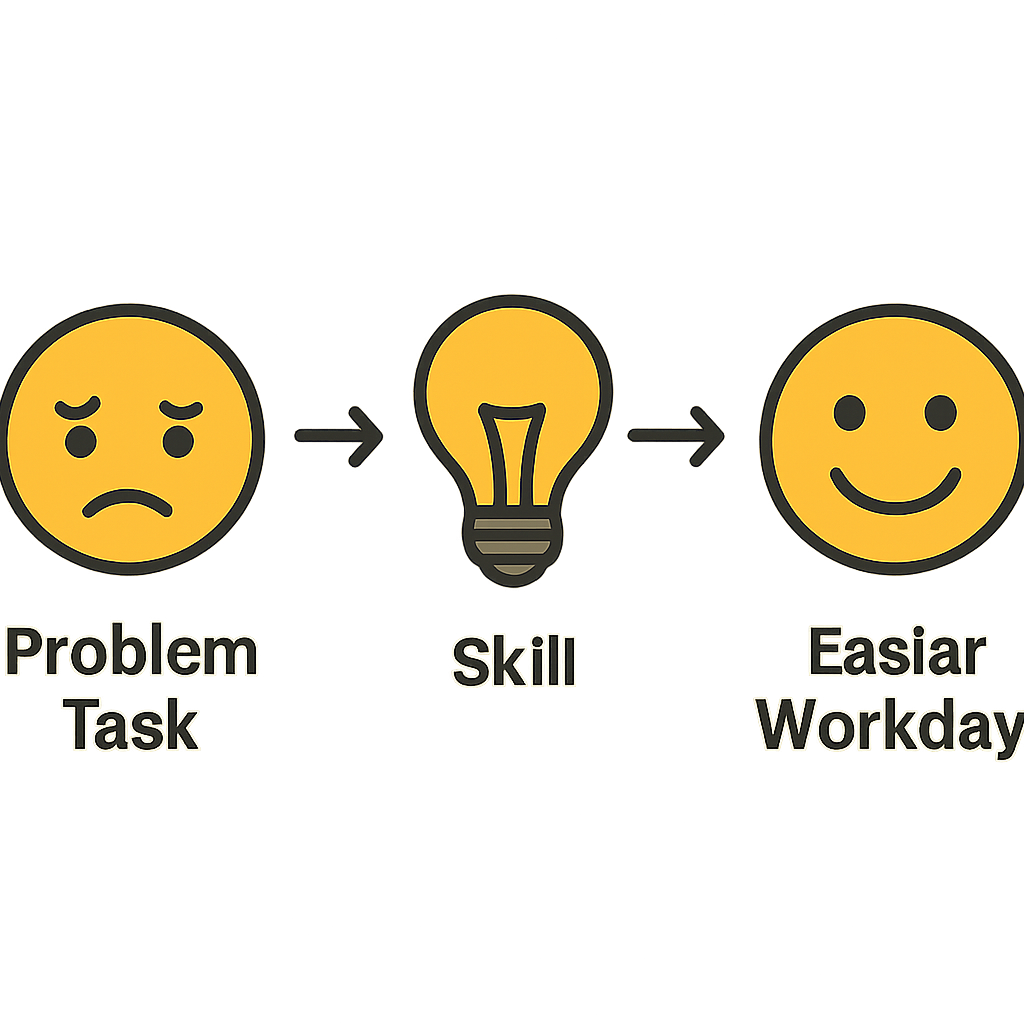
This approach flips professional development from a long-term, abstract goal into an immediate source of relief. Learning how to automate that report doesn’t just look good on a review; it gives you back three hours of your week. Mastering a few communication techniques doesn’t just prepare you for a future promotion; it makes tomorrow’s team meeting less stressful. This is how you start overcoming career plateau challenges—by scoring small, meaningful wins that make your current job better today.
Focusing on your immediate needs helps you choose a skill that will definitely pay off. But it also raises a new question: Is the goal to get better at the job you have, or to prepare for a completely different one? Answering this question determines your next step.
Should You Get Better or Get Different? Upskilling vs. Reskilling Explained
That question—whether to improve your current work or prepare for something new—is the foundation of smart personal development. Think of it this way: are you sharpening the tools you already have, or are you building a brand-new toolbox? Both paths are valuable, but they lead to very different destinations. Knowing which one you’re on is the key to making sure your efforts pay off.
When you focus on sharpening your existing tools, you’re upskilling. This means getting better at the job you already do. For example, if you’re a customer service rep who learns your company’s new scheduling software, you’re upskilling. You become more efficient, more valuable in your current role, and put yourself in a stronger position for a raise or promotion. This path is about building mastery and achieving career advancement where you are.
In contrast, building a new toolbox is reskilling. This is about learning a fundamentally different set of skills to move into a new role or even a new industry. An administrative assistant taking online courses in digital marketing is reskilling. They aren’t trying to become a better assistant; they’re preparing for a career change. This path is about creating new opportunities for yourself.
Deciding between upskilling vs reskilling simply comes down to your goal. Do you want to grow in your current field, or do you feel a pull toward something entirely different? Whichever path you choose, some skills are universally powerful. They’re the foundation for both getting better and getting different, making you more effective no matter your title.
The ‘Hidden’ Job Skills That Get You Promoted: A Guide to Soft Skills
Those universally powerful skills we just mentioned? They have a name: soft skills. Don’t let the name fool you; there’s nothing “soft” about them. These are the practical, everyday abilities that determine how you communicate, collaborate, and handle challenges. Unlike technical skills (like using a specific software), soft skills are about how you work with people, making them valuable in any role.
While technical abilities get you in the door, soft skills are what help you move up. Managers look for these qualities when considering people for leadership roles. Think about it: who would you rather have on your team? Someone who just points out problems, or someone who helps find a solution? Here are three of the most important soft skills:
- Clear Communication: Writing emails people can understand in 30 seconds.
- Collaboration: Knowing how to ask for help and offer it effectively.
- Problem-Solving: Seeing an issue and suggesting a solution, not just flagging it.
Developing these skills is the foundation of soft skills training for leadership roles because it shows you can think beyond your immediate tasks. When you communicate clearly and help solve problems, you make your manager’s job easier and lift the entire team. This is how you signal you’re ready for more responsibility. A great way to build these skills is through observation or even informal mentorship, where you can see how experienced colleagues navigate tough situations.
You can start improving today with one simple change. The next time you have to report a problem, take five minutes to also bring one potential solution. It doesn’t have to be perfect, but it instantly changes your message from “Here’s a problem for you” to “Here’s a challenge we can solve.”
How to Create a Simple Career Growth Plan You’ll Actually Use
Thinking about skills like communication and problem-solving is the first step, but without a simple map, even the best intentions can get lost in the daily grind. This is where a personal career growth plan comes in—not a stuffy corporate document, but a one-page guide for you, by you. It helps turn a vague idea like “get better at my job” into a clear, achievable goal. The secret is to keep it incredibly simple so you don’t get overwhelmed.
The most effective plans are the ones you stick with. To create your own, just answer three questions. This simple individual development plan template helps you connect your ambitions to a tangible skill and, most importantly, a single starting point. For example, what are examples of career goals you might have? It could be anything from earning a promotion to simply feeling less stressed.
Your 1-Page Development Plan:
- My Goal: (e.g., “Feel more confident contributing in team meetings.”)
- The Skill I Need: (e.g., “Structuring my ideas before I speak.”)
- My First Action: (e.g., “This week, I will write down ONE talking point before our team huddle and practice saying it.”)
Notice how the most important part of that plan is the final step: “My First Action.” Don’t try to “master communication” in a week. Instead, focus on that one tiny, concrete task. By breaking a big goal into a manageable first step, you build momentum and make progress feel inevitable. Once you know what skill you want to practice, the next logical question is where to find the right help.
Where to Find High-Value Training That Doesn’t Cost a Fortune
Okay, you have your “First Action.” Now, where do you go for help? The good news is, you don’t need an expensive subscription or a company budget to start learning. The internet is overflowing with free training, but the real challenge is sorting the valuable from the vague. The secret isn’t finding the flashiest course; it’s finding the right tool for your specific goal.
Your search can start with powerful sources you might be overlooking. Beyond random tutorials, look for official channels on YouTube from software companies or respected industry experts. Don’t forget your local public library, which often provides free digital access to premium learning platforms like LinkedIn Learning. For any software-related skill, the official documentation or “help” section is a goldmine written by the people who built the tool.
Before you invest your time in a free resource, ask a simple vetting question: “Who made this and why?” A video from a long-time professional sharing their expertise is often more useful than a slick ad trying to sell you something. The best online courses for career advancement are typically taught by people with verifiable, real-world experience, not just good marketers. Look for clear explanations and practical examples you can apply directly to your work.
While some fields have formal continuing education credits requirements, most of us simply need to solve a problem. Resist the urge to chase the top certifications to boost your resume without a clear purpose. A 20-minute video that helps you master that frustrating spreadsheet formula is far more valuable than a 10-hour course you never finish. Sometimes, though, the most direct path to learning a new skill isn’t a course at all, but a conversation with someone who’s already mastered it.
Forget a Mentor, Find a Moment
The word “mentor” can sound intimidating, bringing to mind a formal, life-changing relationship that seems hard to find. But what if you don’t need one mentor? What if you just need a 15-minute conversation? This shift in thinking is the key to unlocking advice from experienced people around you without the pressure of a long-term commitment.
Instead of asking someone, “Will you be my mentor?”, think smaller. Focus on asking for help with one specific thing you admire about their work. This approach turns a daunting request into a simple, manageable one that busy people are far more likely to accept. You’re not asking for a guide for your whole career; you’re just asking for directions to the next town. This is how you start building a personal learning network—one conversation at a time.
Your ideal person for this isn’t always the top executive. It could be a peer who excels at presentations or a team lead in another department whose work you respect. The next time you identify a skill you want to develop, try sending a message like this: “Hi [Name], I really admire how you [do the specific skill, e.g., handle difficult client questions]. Would you have 15 minutes sometime next week to share how you approach it? I’m trying to get better in that area.”
This simple, specific request respects their time and makes it easy for them to say yes. Each short conversation gives you a valuable piece of the puzzle, showing you how mentorship supports career progression in a practical way. These interactions don’t just build your skills; they build your confidence and demonstrate the proactive mindset behind all great leadership skills. You’re not just learning a trick; you’re learning how to learn from others.
Take Control of Your Career Today
Before, “professional development” might have seemed like a vague, corporate term—something that was done to you. Now you see it for what it truly is: your personal toolkit for taking control. You no longer have to wait for permission or a formal program to start growing. You now have a simple way to decide what to learn and the power to act on it yourself.
Let’s turn that power into momentum. Don’t let this be just another article you read. Right now, open a new browser tab. Think of that one frustrating task we identified earlier and search for “[Task] tutorial” or “[Skill] for beginners.” Find one video or article that looks helpful and bookmark it. That’s it. You’ve just created step one of your own career growth plan.
That small click is more than just a bookmark; it’s a decision to invest in yourself. This is how meaningful progress is made—not in giant leaps, but in small, consistent actions. Soon, you’ll be measuring the impact of your training not with certificates, but with hours saved and confidence gained. You are in the driver’s seat of your career.