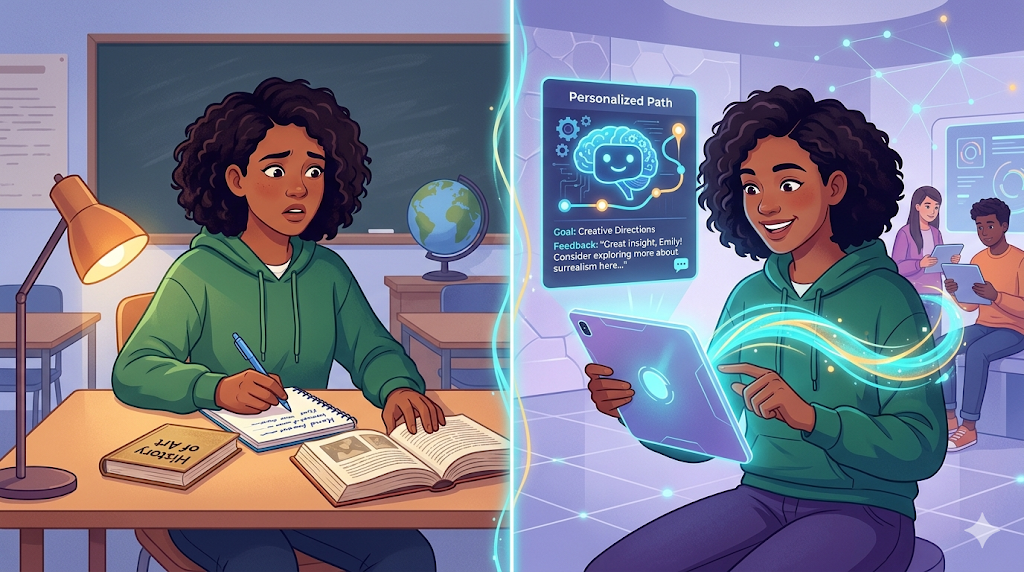
The best time to master new technology is now, yet many assume quality education requires expensive bootcamps. In reality, tech giants like Google and Microsoft are releasing their top-tier training at zero cost because they need a global workforce ready to use their tools.
Grasping these concepts starts with distinguishing AI Engineering (building the engine) from AI Literacy (driving the car). You don’t need complex calculus to succeed; most professionals simply need to understand how to apply these systems to daily tasks.

Finding how and where to learn AI for free often leads to the “Audit” button, a secret feature granting access to university courses without tuition. This roadmap skips the math to focus on practical skills you can use immediately.
How to Access Stanford and Ivy League Lectures Without the $50k Tuition
Top-tier education usually comes with a massive price tag, leading many to believe that credible AI training is out of reach. However, platforms known as MOOCs (Massive Open Online Courses) host content directly from institutions like Stanford and MIT for the public. While these sites aggressively market paid certificates, the actual learning materials—including video lectures and reading lists—are frequently available for free if you know how to navigate the interface.
Finding this free path requires looking past the large “Subscribe” buttons to locate the “audit” feature. This option allows you to watch the exact same lectures as paying students, such as those in Andrew Ng’s highly recommended Machine Learning course, without spending money. To access these Stanford University free AI lectures online, simply follow this workflow:
- Click the primary “Enroll” button on the course page.
- Ignore the pop-up prompting you to start a free trial or enter payment info.
- Look for a small text link, usually at the bottom of the window, that says “Audit,” “Audit this course,” or “Continue without certificate.”
Choosing the Coursera vs edX free audit options means you prioritize acquiring skills over receiving a digital badge. You get the knowledge necessary to understand the technology, while the paid version is strictly for those needing administrative verification for an employer. Once you have secured access to these academic foundations, you may want to supplement them with more casual, digestible explanations found on social video platforms.
The Best YouTube Mentors Who Make Machine Learning Feel Like a Hobby
While university lectures provide the bedrock of theory, they often lack the visual flair needed to make abstract concepts click. Thinking of an algorithm as a math formula is hard; seeing it visualized as a decision tree or a flowing river makes it intuitive. YouTube has democratized this style of education, offering a roadmap for self-taught AI engineers that focuses on “aha!” moments rather than dry textbook memorization. By curating specific playlists, you can build a personalized curriculum that rivals paid bootcamps in quality but feels more like watching a documentary series.
To cut through the noise of clickbait influencers, focus your attention on these top free resources for generative AI beginners:
- StatQuest with Josh Starmer: Famous for stripping away scary math and replacing it with catchy songs and clear graphics, making it one of the best YouTube channels for learning machine learning.
- 365 Data Science: Excellent for high-level overviews that explain career paths and how different data roles actually function in a real business.
- Sentdex: Offers practical, hands-on tutorials that show you exactly what happens when you press “run” on a project.
Watching these mentors breaks down the intimidation factor, proving that neural networks are just layers of simple math working together. Once you understand the “why” behind the technology through these visual guides, the next logical step is to get your hands dirty with the “how.” The actual language used to communicate with AI tools is far more accessible than most people realize.
Learning Python and Data Basics Without a Math Degree
Most people assume learning Python for data science and AI requires memorizing a massive dictionary, but you actually only need a traveler’s phrasebook. You aren’t trying to build a video game or a website; you are simply giving instructions to data. By focusing strictly on specific data tasks, you can ignore 80% of generic coding rules and fast-track your progress.
Python becomes powerful when you use “libraries”—pre-written bundles of code that function like specialized Lego blocks. Instead of building a tool from scratch, you just snap these existing blocks together. To practice machine learning without a degree, you focus on four essentials:
- NumPy: Handles the heavy math calculations instantly.
- Pandas: Organizes messy data into neat tables, like Excel on steroids.
- Matplotlib: Turns your numbers into clear charts and graphs.
- Scikit-learn: The actual toolkit that builds predictions and models.
Getting started is easier than ever because you no longer need to install complex software on your own computer. Free platforms like Kaggle and Replit provide “coding sandboxes” where everything is pre-installed in your web browser. This eliminates technical headaches and answers the question, “can I learn deep learning without math or a supercomputer?” Yes, because the cloud handles the heavy lifting. With these basics in hand, you are ready to earn official recognition for your new skills.
How to Get Official ‘Generative AI’ Badges from Google and Microsoft for Free
You do not need to pay university tuition to prove you are keeping up with technology. Tech giants are currently competing to train the workforce, meaning the best free AI bootcamps usually come directly from the source. Microsoft and Google provide comprehensive courses that award “digital badges”—verified credentials you can add to your LinkedIn profile to show employers you understand the fundamentals without needing to write complex code.
The Google Cloud Generative AI Learning Path is arguably the gold standard for beginners because it focuses on clear concepts rather than heavy mathematics. To start earning your first badge immediately:
- Navigate to the “Google Cloud Skills Boost” website and select the “Introduction to Generative AI” course.
- Watch the 22-minute video explaining how Large Language Models (LLMs) predict patterns.
- Pass the short quiz to instantly receive your verified completion badge.
Beyond collecting credentials, these courses teach you that interacting with AI is less about technical commands and more about clear communication. Most top free resources for generative AI beginners emphasize a simple formula for success: Context + Task + Constraints. Instead of vaguely asking “Write an email,” you say, “Act as a property manager (Context), write a renewal notice (Task), and keep it under 100 words (Constraint).” Mastering this formula is the first step toward building a tangible body of work.
Building a ‘Zero-Dollar’ Portfolio: How to Prove You Know AI
Earning a badge proves you watched the videos, but applying those skills to real data proves you understand them. In the tech world, a visible collection of finished projects often carries more weight than a traditional degree because it demonstrates practical ability rather than just theory. You can start building a machine learning portfolio for free by documenting simple tasks, such as using AI to organize your digital photo library or analyzing public data trends, effectively creating a “proof of work” that employers or collaborators can actually verify.
Finding specific problems to solve is easier than you might expect thanks to platforms like Kaggle, which operates like a massive playground containing thousands of practice datasets. Once you have a project, you can store your work on GitHub, a platform that uses “version control”—think of it as a rigorous “Track Changes” history for your files—allowing you to showcase your progress publicly. Participating in open source AI projects for beginners on these sites lets you learn directly from the community, peering over the shoulders of experienced engineers to see exactly how they solve problems.
To support your hands-on practice, you should supplement your experimenting with structured reading from the academic community. Many top researchers release free artificial intelligence textbooks and PDFs that explain the “why” behind the tools you are using, ensuring your foundational knowledge remains solid even as the software changes. With your badges earned, your portfolio started, and your library stocked, you are now ready to structure these resources into a concrete plan of action.
Your 30-Day AI Roadmap: From Curious Explorer to Confident Builder
You have moved from feeling overwhelmed by technical jargon to holding a clear map of high-quality resources. The secret to mastering these tools isn’t finding more videos, but shifting from passive watching to active experimenting. To turn this new knowledge into muscle memory, commit to this simple 30-day schedule:
- Week 1: Master the basics with Google’s introductory courses.
- Week 2: Experiment with prompting in ChatGPT or Gemini.
- Week 3: Automate one daily email or spreadsheet task.
- Week 4: Create a small personal project to showcase skills.
This approach provides a durable roadmap for self-taught AI engineers and everyday users alike. You now know exactly how and where to learn AI for free; the only step left is to open your first tool and start building.