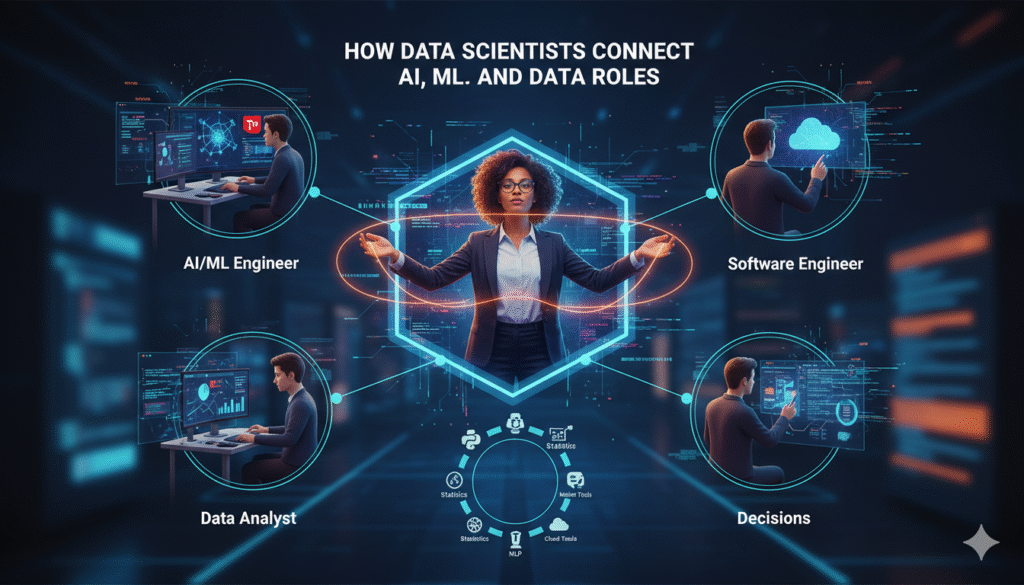
Let’s understand how a Data Scientist serves as a bridge between key roles in an AI ecosystem:

1️⃣ Machine Learning Engineer (AI/ML Engineer)
Machine Learning Engineers focus on creating and fine-tuning ML models that can solve real-world problems — from predicting sales trends to powering recommendation systems.
Key Skills: Python, TensorFlow, PyTorch, MLOps, and Cloud Platforms.
2️⃣ Data Analyst
A Data Analyst’s main role is to translate raw data into actionable insights. They use data visualization, dashboards, and reports to help businesses make informed decisions.
Key Skills: SQL, Excel, Power BI, Tableau, Statistics, and Python (pandas).
3️⃣ Software Engineer (AI Tools & Integration)
Software Engineers working with AI build and maintain the systems that make AI work seamlessly. They handle model deployment, scalability, and automation.
Key Skills: Java, Python, APIs, Cloud Services (AWS, Azure), and CI/CD.
At the Center: The Data Scientist
A Data Scientist sits at the intersection of all these roles — orchestrating them like a conductor leading an orchestra. Their expertise spans across multiple domains:
✅ Programming: Python, R, SQL
✅ Mathematics & Statistics: Linear Algebra, Probability, Hypothesis Testing
✅ Machine Learning: Supervised & Unsupervised Learning, Deep Learning
✅ Specialized Areas: Natural Language Processing (NLP), Computer Vision
✅ Big Data & MLOps Tools: Hadoop, Spark, Kubernetes, Docker
They not only analyze data but also understand the story behind it — turning algorithms into business outcomes.
💡 Tips for Beginners
If you’re starting your journey into Data Science, begin with the core building blocks:
- Learn Python programming — your foundation for data analysis and ML.
- Strengthen your statistics and math concepts.
- Explore Machine Learning fundamentals using simple datasets and tools like Scikit-learn or Google Colab.
Once you’re confident, dive into specialization areas like Deep Learning, NLP, or MLOps — depending on your interests.

💬 For Professionals
If you’re already in the field, focus on expanding your cross-functional expertise. Learn how data flows through pipelines, how models are deployed in production, and how cloud platforms support scalability.
These skills make you indispensable in any AI-driven organization.
🔥 The Truth About Data Science
Data Science is not just about building models.
It’s about creating meaningful connections between data and decisions — ensuring that technology serves people, not the other way around.

In the end, a true Data Scientist doesn’t just work with data — they breathe life into it, transforming it into knowledge that powers the future.