Introduction: The Emergence of Agentic AI.
The year 2026 will be the beginning of a new era – the year of Agentic AI.
Chatbots are no longer a response-only system, nowadays AI models can reason, perform actions, and cooperate just as online colleagues. These AI agents are changing industries, automating complicated processes, and changing the relationship between humans and technology.
In case you have ever asked yourself: How can I begin to learn AI agents? — this is your total roadmap to become an amateur to a builder.
Level 1: Construct your GenAI and RAG Foundation.
You must first get familiar with the fundamentals that agents are built upon Generative AI and Retrieval-Augmented Generation (RAG).
Here’s what to focus on:
Begin by understanding what Generative AI is in practice, i.e. models capable of generating text, images, and even code.
Get to know about such tools as ChatGPT, Gemini, and Claude, and learn how they produce human-like results.
The brains of agents are what are called Large Language Models (LLM) such as GPT-4.
Learn their training, the meaning of parameters, and how language is processed by transformers.
3 Fundamentals of Prompt Engineering.
Your method of programming the AI is to prompt.
Few-shot prompting, chain-of-thought, and role prompting are the methods that can be learned to achieve accurate and reliable results.
4 Data Handling & Processing
Every AI agent needs data. Learn how to:
Clean and structure data
Use such vector databases as Pinecone, FAISS, or Chroma.
Know embeddings and semantic search.
5 API Wrappers & RAG Essentials
Lastly, learn to bridge your model and the real world using APIs.
Next, enter RAG (Retrieval-Augmented Generation) – adding your data to model intelligence and get better answers.
Level 2: Dive into Agentic AI
After establishing your base, it is time to learn more about the way agents think and behave.
6 Introduction to AI Agents
An AI Agent is a system that is not only able to comprehend instructions, but also make decisions, take actions and learn through feedback.
Imagine it to be your independent assistant who can plan and perform.
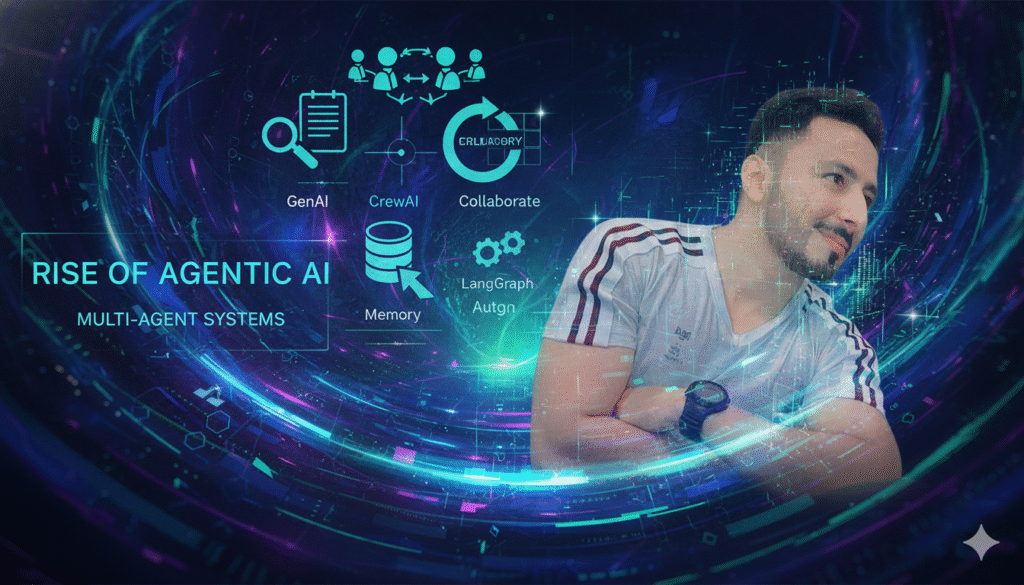
7 Learn Agentic Frameworks
Creating agents in the real world will require appropriate frameworks. Start with:
CrewAI – to work together with other agents.
LangGraph – to design agentic workflow.
AutoGen – conversational agents.
PhiData – to manage agent memory and contexts.
These structures make the entire process of reasoning, memory and tool-calling simpler.
8 Build a Simple AI Agent
Begin small – create an agent that:
Searches the web
Extracts information
Automatical report or email writing.
Python libraries such as LangChain or the function calling of OpenAI do this.
9 Get to Know Agentic Memory & Workflows.
Memory enables the agents to remember the previous discussions and change as time goes by.
Learn how to implement:
Short-term memory (context windows)
Long-term (vector databases) memory.
Task orchestration Workflow.
Multi- Agent Cooperation and Assessment.
Multi-agent systems are the way forward – agents collaborate in order to solve complex problems.
Experiment with:
Agents to agents communication protocols.
Role-based collaboration
Real-life task performance evaluation.
The End Product: Developing Self-directed Intelligence.
In doing this roadmap, you will know and be able to create your own intelligent, autonomous AI agents – who are able to reason, plan and act on their own.
It is not only a trip to code, but to create the future of digital intelligence.