Introduction
The question isn’t whether Artificial Intelligence (AI) will change the job market it’s how profoundly and how fast. The integration of sophisticated AI tools, particularly Generative AI like large language models, into the core of business operations marks a watershed moment, shifting the focus from simple job displacement to complex job reshaping.
While anxieties over mass unemployment dominate headlines, the real-world data points to a more nuanced, but equally urgent, truth: AI is both an automator and an augmenter. It’s eliminating tasks and creating new roles, raising productivity to unprecedented levels, and demanding that every professional rethink their value proposition. The future of work isn’t human versus machine; it’s human plus machine.
The Economics of Automation: Displacement vs. Augmentation (E.E.A.T. Focus)
For an authoritative and trustworthy understanding, we must look at recent economic and industry analysis.
The Immediate Impact: Where AI Replaces Tasks
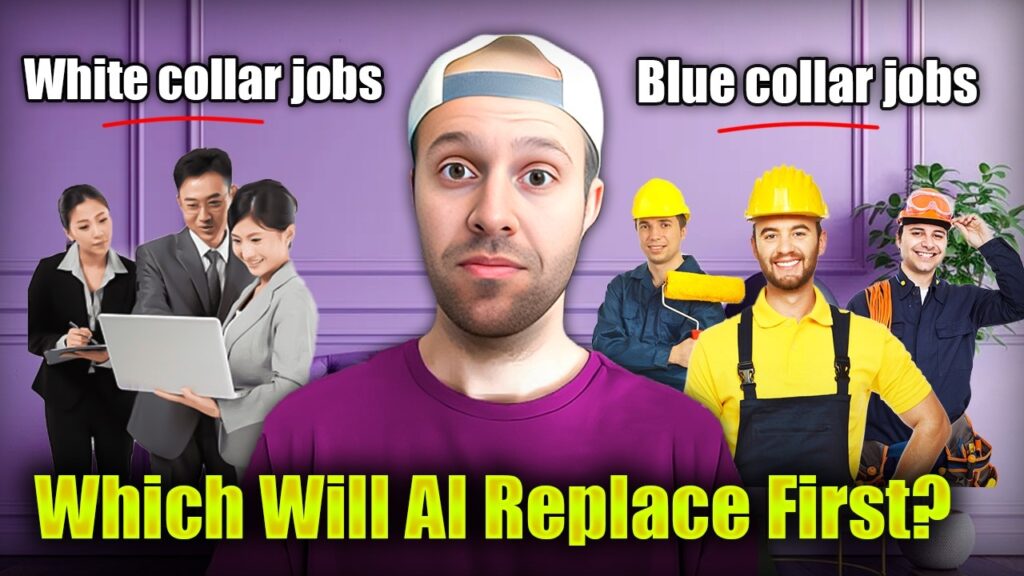
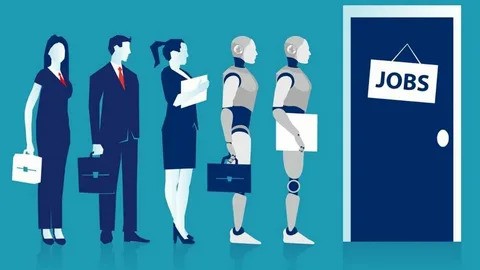
Recent reports from institutions like Goldman Sachs and PwC suggest that the initial wave of AI impact is concentrating on jobs rich in routine, cognitive tasks. This is not necessarily the wholesale elimination of entire job titles, but the automation of 10% to 50% of the tasks within them.
High-Risk Roles (Tasks Most Susceptible to Automation):
- Administrative and Clerical Roles: Data entry clerks, administrative assistants, paralegals, and legal assistants. AI-powered tools excel at summarizing documents, sorting data, and scheduling.
- Customer Service and Telemarketing: Basic customer service inquiries, scripted dialogues, and initial lead outreach are efficiently handled by advanced chatbots and AI voice systems.
- Finance and Accounting: Bookkeeping, payroll processing, and certain types of credit analysis rely on predictable, rules-based calculations that AI automates with high precision.
- Entry-Level Knowledge Work: Due to the AI’s ability to quickly generate first drafts, conduct information research, and write basic code, entry-level roles in technology, content creation, and general research are experiencing hiring headwinds as employers prioritize automation over new hires.
Goldman Sachs research suggests that while AI could ultimately displace 6-7% of the US workforce under a wide adoption scenario, this displacement is often followed by new job creation, making the net unemployment impact temporary and modest. The crucial takeaway is that the workers who thrive will be those who can leverage AI tools to perform their automated tasks faster, shifting their energy to higher-value activities.
The Growth Equation: Where AI Creates New Roles
The other side of the equation is the net job creation and wage premium associated with AI-exposed industries. PwC’s 2025 Global AI Jobs Barometer indicates that:
- Wages are rising twice as fast in AI-exposed industries compared to those least exposed.
- Workers with AI skills (e.g., prompt engineering, AI tool integration) are commanding a significant wage premium, demonstrating a high market value for the ability to work alongside the technology.
This economic shift is creating entirely new, high-growth occupations:
| Category | Example Jobs | AI Function |
| Development | AI and Machine Learning Specialists, Generative AI Engineers | Building, training, and maintaining the AI models themselves. |
| Oversight | AI Ethicists, Prompt Engineers, AI-Human Collaboration Managers | Guiding AI output, ensuring ethical use, and bridging the gap between human strategy and algorithmic execution. |
| Data | Big Data Specialists, FinTech Engineers, Data Analysts | Managing the massive datasets needed to train and operate AI systems. |
Export to Sheets
Tools Reshaping the Workplace: The New Digital Assistants
The modern office is being transformed by powerful, yet accessible, AI tools. Understanding these technologies demonstrates Expertise on the subject.
1. Generative AI (The Content Engine)
The most public-facing tool, Generative AI (GenAI), uses Large Language Models (LLMs) to create new text, code, images, and audio.
- Impact: It’s a force multiplier for marketers, writers, and developers, allowing one person to produce the output of many, automating first drafts, research summaries, and content translation.
2. AI Assistants and Copilots (The Productivity Layer)
Tools like Microsoft Copilot and others embedded in productivity software act as intelligent sidekicks.
- Impact: They automate workflow processes, summarize long email threads, generate meeting action items, and pull data from multiple sources on command, boosting overall efficiency by up to 40% in some cases.
3. Agentic AI (The Autonomous Worker)
This is the next frontier. Agentic AI systems are designed to perform complex, multi-step tasks with minimal human supervision.
- Impact: Instead of just summarizing a document (GenAI), an agent can be tasked to “research three new market trends, draft an executive summary, and schedule a review meeting with the sales team,” operating across multiple applications to achieve a defined goal.
Human-Centric Resilience: The E-E-A-T Strategy for Workers
The new “E” in E-E-A-T—Experience—offers the best roadmap for career longevity. AI’s limitations are the human worker’s greatest strengths.
| AI’s Weakness | Human’s Strength (The AI-Proof Skills) |
| Lacks Empathy & Judgment | Emotional Intelligence: Counseling, nursing, teaching, management, and relationship-heavy sales. |
| Cannot Perform Physical Tasks | Manual/Physical Work: Skilled trades (plumbing, electrical), specialized medical procedures, hands-on maintenance, and physical therapy. |
| Struggles with Novelty & Ethics | Critical Thinking & Creativity: Strategic leadership, complex negotiation, ethical framework design, and original artistic creation (where the unique human experience is the core value). |
Export to Sheets
The Strategy for Success: To thrive, workers must adopt a mindset of continuous upskilling. This means becoming an “AI Power User”—learning to prompt the tools effectively and use the efficiency gains to focus on interpersonal, creative, and strategic tasks that AI simply cannot replicate.
Frequently Asked Questions (FAQs)
Q1: Is the goal of companies to completely replace employees with AI?
A: Not universally. While some companies prioritize cost-cutting through job elimination (especially in highly automatable sectors like data entry and basic administration), the overarching trend is using AI to increase productivity and efficiency. The majority of business leaders see AI as a tool to fill skills gaps and allow existing employees to focus on higher-value, more strategic tasks, ultimately making the company more profitable. For example, a lawyer may use AI to draft briefs 10x faster, but the client still needs the human lawyer’s experience and strategic judgment.
Q2: What should I do if my job is on a “high-risk” list ?
A: Don’t panic, but start learning. Your risk is often related to the tasks you perform, not your job title itself.
- Become an AI Co-Worker: Learn to use the specific AI tools that automate your most repetitive tasks (e.g., if you’re a writer, master GenAI for outlines; if you’re a bookkeeper, learn RPA for data handling).
- Focus on Soft Skills: Strengthen communication, leadership, negotiation, and creative problem-solving—skills that are inherently human.
- Explore Adjacent, Augmented Roles: Transition from being a “Data Entry Clerk” to a “Data Analyst” by learning Python or SQL, or from a “Customer Service Rep” to a “Client Onboarding Specialist” (a role focused on complex, human relationship building).
Q3: How quickly will AI change my job ?
A: The pace is accelerating. While economists predict it will take decades to automate even half of all current work tasks globally, the skills required for many jobs are changing 66% faster in AI-exposed sectors compared to others. This means the time to adapt is now. Focus on AI literacy—the ability to interact with and manage AI tools—as a foundational skill, much like digital literacy became essential twenty years ago.