We often talk about artificial intelligence as a threat to employment — robots taking over factories, algorithms replacing analysts, or AI assistants doing creative work.
But what if the real risk isn’t economic at all?
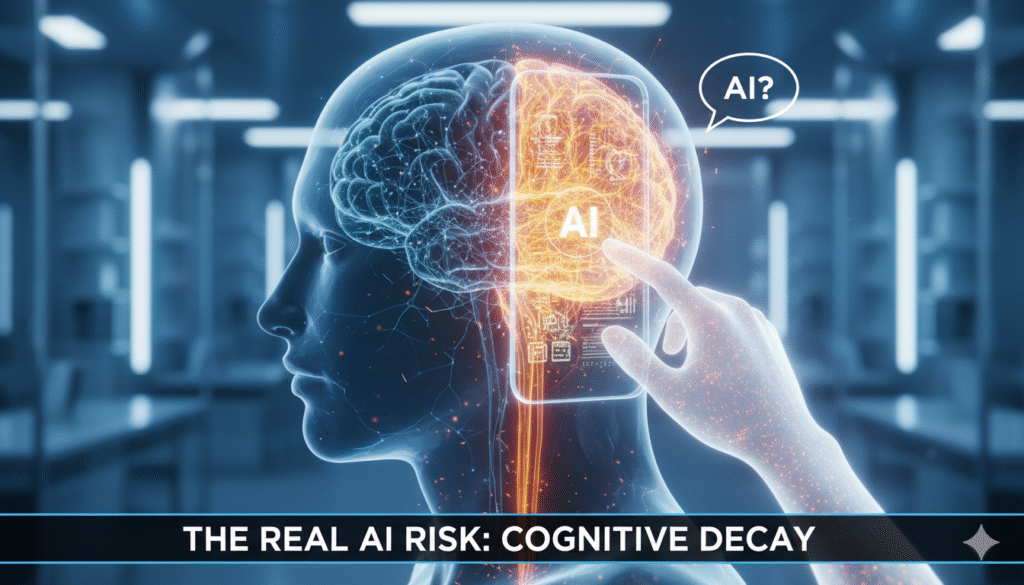
What if the biggest danger of AI is mental — that we’re outsourcing our thinking?
The Subtle Drift Toward Mental Laziness
Every time we ask ChatGPT to write an email, summarize an article, or solve a problem, we’re making a micro-decision: “Should I think this through myself, or should I let AI handle it?”
At first, it feels harmless — even efficient. But over time, those small choices can snowball into something bigger: a gradual weakening of our cognitive muscles.
An upcoming MIT Media Lab preprint offers early evidence of this shift.
Participants were asked to write essays, some with ChatGPT’s help and others without, while researchers tracked brain activity using EEG.
The results were striking:
Those who relied on ChatGPT showed weaker neural engagement — less mental activation during writing. Over several months, these same participants also underperformed on neural, linguistic, and behavioral measures, even struggling to recall or accurately quote their own AI-assisted work.
It’s early data, but the pattern is hard to ignore.
AI Isn’t Making Us Dumb — We Are
This phenomenon isn’t entirely new. Cognitive scientists have long studied a concept called “cognitive offloading” — the tendency to rely on external tools (like Google or smartphones) instead of our own memory.
When information is always available, we don’t store it — we just remember where to find it.
AI tools like ChatGPT take that convenience to a new level. They don’t just store information — they generate it, often faster than we can think.
The result? A quiet erosion of the very skills that make thinking meaningful: reasoning, reflection, creativity, and memory.
The New Skill: Thinking With AI, Not Through It
None of this means we should avoid AI. It’s an incredible amplifier of human potential — if used consciously.
The challenge isn’t whether to use AI, but how.
We need to learn a new discipline: using AI without turning off our brains.
That means:
- Treating AI as a collaborator, not a crutch.
- Using it to challenge ideas, not replace them.
- Asking better prompts, then verifying and expanding on what it gives.
- Writing drafts before asking AI for feedback — not after.
- Staying mentally present in the process.
Think of it like using a calculator: it’s powerful, but if you never do the math yourself, you’ll soon forget how numbers actually work.
The Real Future of Intelligence
As AI grows more capable, the people who thrive won’t be those who use it the most — but those who use it most thoughtfully.
The real superpower isn’t automation. It’s metacognition: knowing when to think deeply, when to delegate, and when to double-check.
We don’t need to fear AI taking over.
We need to fear not noticing when we’ve stopped thinking.