How AI Tutors and Gamification Are Revolutionizing K-12 STEM Education in 2026
The intersection of artificial intelligence and interactive gaming is driving one of the fastest-growing shifts in modern EdTech. For years, educators struggled to balance student engagement with rigorous academic standards. Traditional homework assignments often lead to fatigue, while purely recreational screen time offers little educational value.
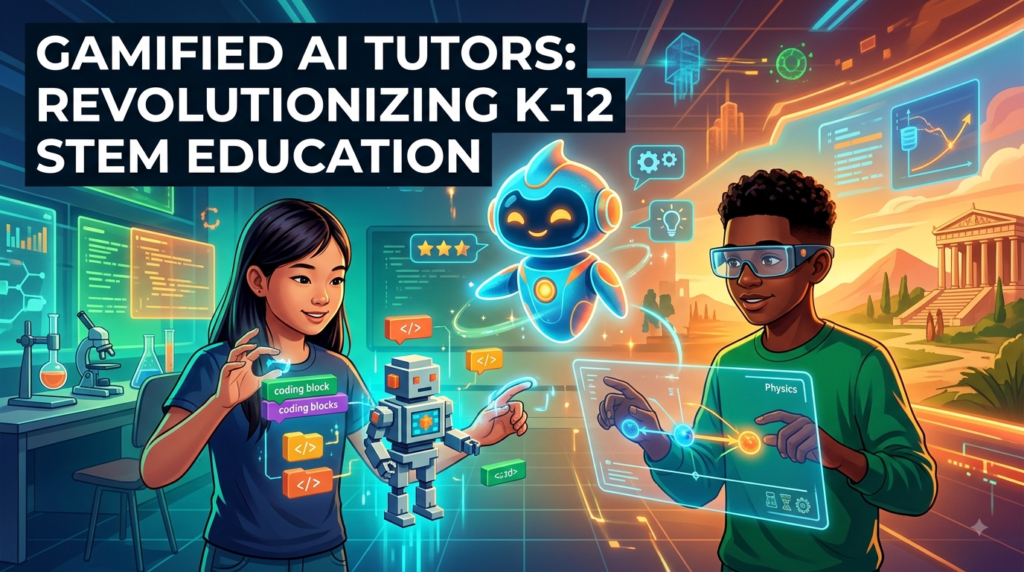
In 2026, the breakthrough solution lies in Gamified AI Learning—the integration of real-time, adaptive generative AI models directly into immersive gaming environments like Minecraft, Roblox, and dedicated learning sandboxes.
This deep dive explores how AI-powered game mechanics are reshaping science, technology, engineering, and mathematics (STEM) education for K-12 students, why parents and schools are adopting these tools at record rates, and what it means for the future of learning.
The Shift from Passive Consumption to Active Gamified AI
Standard educational technology relied heavily on digitized worksheets and linear videos. While helpful, these static tools lack personal adaptation. If a student stalls on an algebra concept or a coding logic loop, static software offers no immediate customized intervention.
Generative AI agents embedded inside interactive gaming spaces change this dynamic entirely:
- Dynamic Quest Generation: AI algorithms assess a student’s current proficiency level and instantly create custom quests or puzzles tailored to their knowledge gaps.
- Non-Player Character (NPC) Mentors: Interactive AI tutors act as in-game guides, answering questions in natural language without breaking game immersion.
- Failure as Progression: Instead of a red mark on a test, dynamic gaming turns incorrect answers into tactical challenges, encouraging trial, error, and resilience.
4 Ways Gamified AI Is Transforming K-12 Classrooms
+-----------------------------------------------------------------------+
|                       Gamified AI Learning Loop                       |
|                                                                       |
|  [Student Interacts in Game] ---> [AI Monitors Real-Time Mastery]     |
|              ^                                    |                   |
|              |                                    v                   |
|  [Customized Gameplay Challenge] <--- [Dynamic Quest Adjustment]      |
+-----------------------------------------------------------------------+
1. AI-Driven Coding Tutors in Sandbox Environments
Sandbox games have moved far beyond building digital structures. With integrated AI coding tutors, students write Python or JavaScript snippets to automate tasks inside the game world. When a syntax error occurs, the AI tutor doesn’t just display an error message; it offers contextual clues through an in-game assistant character, guiding the student to debug their own logic.
2. Personalized Math & Physics Puzzles
Math concepts frequently feel abstract to young learners. Gamified AI translates spatial equations, physics trajectories, and algebraic ratios into physical mechanics inside a game engine. If a student struggles with projectile motion, the AI adjusts gravity parameters or trajectory lines in real time to visualize the math behind the movement.
3. Continuous Micro-Assessments
Traditional testing creates anxiety and interrupts the learning process. AI-powered games implement continuous micro-assessments in the background. As students solve challenges, the AI logs data on problem-solving speed, spatial reasoning, and critical thinking skills, generating comprehensive mastery dashboards for teachers and parents without taking time out for formal exams.
4. Language and Logic Simulation
Beyond hard science, language learning and logical reasoning are flourishing within role-playing game (RPG) AI setups. Students interact with AI conversational agents in foreign languages or participate in simulated historical debates, receiving instant feedback on vocabulary, syntax, and reasoning strength.
Top Gamified AI Education Trends in 2026
| Platform / Tool Type | Primary AI Feature | Target Grade Level | Primary Learning Benefit |
| Interactive AI Sandboxes | Autonomous NPC Mentors & Coding Assistance | Grades 3–8 | Hands-on computer science logic and spatial problem solving |
| Adaptive Math RPGs | Real-Time Difficulty Scaling & Visual Proofs | Grades K–6 | Eliminates math anxiety through low-stakes play mechanics |
| AI Physics Simulators | Predictive Modeling & Dynamic Constraint Tuning | Grades 7–12 | Intuitive mastery of mechanics, energy transfer, and calculus |
| AI Language Quests | Natural Language Conversational NPCs | Grades 5–12 | Immersive fluency training with real-time grammar feedback |
Overcoming Challenges: Screen Time and Data Privacy
While the benefits of gamified AI learning are clear, modern implementation requires thoughtful guidelines:
- Data Security & Student Privacy: Schools and parents must ensure platforms strictly comply with COPPA (Children’s Online Privacy Protection Act) and FERPA standards, prohibiting the training of public AI models on student interaction data.
- Balancing Screen Time: Gamified AI works best when paired with offline hands-on experiments, group work, and physical activity. Leading schools use dynamic games for 20-to-30-minute high-engagement bursts rather than prolonged screen sessions.
The Road Ahead for Interactive EdTech
As multimodal AI models become faster and more integrated, the boundary between playing a game and mastering a complex academic topic will continue to blur. Gamified AI tutors represent more than a passing trend—they represent a fundamental evolution toward personalized, engaging, and highly effective education.
For educators, parents, and students, the message is simple: learning is no longer a passive chore, but an interactive journey driven by curiosity and supported by intelligent design.