AI is not just a novelty in America’s classrooms; it’s integral to the educational landscape. From the moment a prospective student begins looking for a degree program to the moment a teacher grades an assignment, AI is driving the experience. The debate is now not whether to use AI but how to use AI to improve learning outcomes and operational efficiencies, in 2025 and 2026.
For educational technology platforms like www.aisohail.com, understanding these shifts is critical. Here is a breakdown of the three major AI trends transforming U.S. education right now.
1. The Rise of “AI Search” in Higher Education Discovery
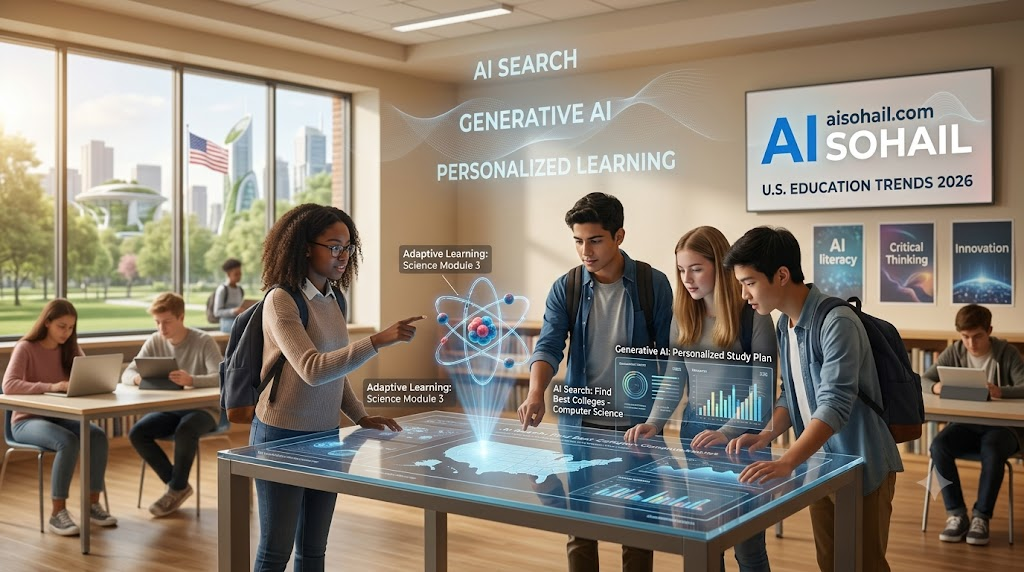
While much of the focus has been on what happens inside the classroom, AI is completely rewriting how students even find those classrooms. “AI Search” has become a dominant force in student recruitment and program discovery.
According to a late 2025 study by UPCEA and Search Influence:
50% of prospective students now use AI tools (like ChatGPT, Gemini, or Perplexity) at least weekly to research programs and institutions.
1 in 3 prospects explicitly trust AI tools for their program research.
What this means: Best computer science degrees” is no longer a Google search students have to do. They’re interacting with AI for conversations about what they should consider, comparing tuition, modality, career prospects. However, if an educational institution (or an EdTech platform) lacks authoritative, structured and accurate content that these Large Language Models can readily scour and regenerate, it could end up on the losing end of half of its intended audience. To succeed in AI-generated responses, institutions have to focus on making their program pages “citation-ready.
2. Generative AI Has Reached Universal Classroom Adoption
The speed at which generative AI has been adopted by both students and teachers is unprecedented.
Recent 2025 and 2026 statistics highlight a wholesale transformation of the learning environment:
- Student Usage: By 2025, student AI usage jumped to a staggering 92%, up from 66% the year prior. In higher education specifically, roughly 90% of college students in 2026 use AI as a primary research and brainstorming partner.
- Teacher Usage: 83% of K-12 teachers are currently utilizing generative AI for lesson planning, administrative tasks, and content support.
The Workflow Shift: The use cases of AI have now shifted towards real world productivity. These tools enable teachers to save an average of 5.9 hours per week — which is the equivalent of 6 full weeks of schooling per year. Students are already using AI extensively to summarize, explain, and develop ideas for assignments.Students already use AI to summarize, explain, and ideate for assignments.
The focus in 2026 is teaching AI Literacy: helping students understand how to use these tools for brainstorming and tutoring without crossing the line into academic dishonesty or losing their critical thinking skills.
3. Measurable Impact: AI Tutors and Personalized Learning
The true value of AI in 2026 isn’t just adoption; it is the measurable impact on learning outcomes. “Personalized Learning” is the driving force behind this success.
A June 2025 Harvard study published in Scientific Reports found that students using pedagogical, well-designed AI tutors learned more than twice as much in less time compared to those in traditional active-learning classrooms. Furthermore, students in AI-enhanced learning environments are seeing test scores rise by up to 54% compared to traditional settings.
The Mechanism: AI achieves this through adaptive learning. Platforms can now assess a student’s skill level in real-time, instantly adjusting the difficulty of questions or providing immediate, customized feedback. This allows students to master concepts at their own pace, effectively replicating the benefits of 1-on-1 human tutoring at scale.
The Path Forward
The U.S. AI in education market is projected to reach $32.64 billion by 2034, proving this is not a passing phase. However, as the OECD notes, challenges remain regarding academic integrity, algorithmic bias, and data privacy. The ultimate goal for 2026 and beyond is finding the balance: using AI to automate the administrative burden and personalize the learning experience, while keeping human educators at the center of the classroom to foster connection and critical thought.