
Artificial Intelligence is no longer just a futuristic buzzword; it is a foundational technology reshaping everyday life and industries from healthcare to finance. At its core, AI relies on vast amounts of data, machine learning algorithms, and neural networks to simulate human problem-solving and adapt over time. While it offers incredible opportunities for efficiency and innovation, understanding these basics is the critical first step to navigating the ethical challenges, privacy risks, and workforce shifts that come with this digital revolution.
Artificial Intelligence, or AI, is transforming our world. It mimics human intelligence in machines, making them smart.

AI is not just a buzzword. It’s a powerful technology with vast potential. From healthcare to finance, AI is everywhere.
Understanding AI basics is crucial today. It helps us navigate the digital age and its rapid changes.
AI technology is complex but fascinating. It involves algorithms, data, and machine learning. These elements work together to create intelligent systems.
AI can perform tasks that once required human intelligence. This includes recognizing speech, making decisions, and even driving cars.
The history of AI is rich and intriguing. It dates back to ancient myths and has evolved through decades of research.
AI’s future is promising. It holds the potential to revolutionize industries and improve our lives.
This guide will explore AI fundamentals. We’ll cover its history, key concepts, and applications. Let’s dive into the world of AI.
What is Artificial Intelligence? An Overview
Artificial Intelligence, or AI, is the development of machines that can perform tasks requiring human-like intelligence. This includes problem-solving, understanding language, and recognizing patterns or images.
AI systems use algorithms to process and analyze data, simulating cognitive functions. These functions empower machines to learn from experience, adapt to new inputs, and perform human-like tasks efficiently.
A core aspect of AI is its ability to improve over time. As AI processes more data, it gets “smarter,” increasing its capability to make accurate predictions.
There are different types of AI, each serving unique purposes. This diversity allows AI technologies to suit various applications and industries.
Common uses of AI include:
- Automating customer service
- Enhancing medical diagnostics
- Powering virtual assistants
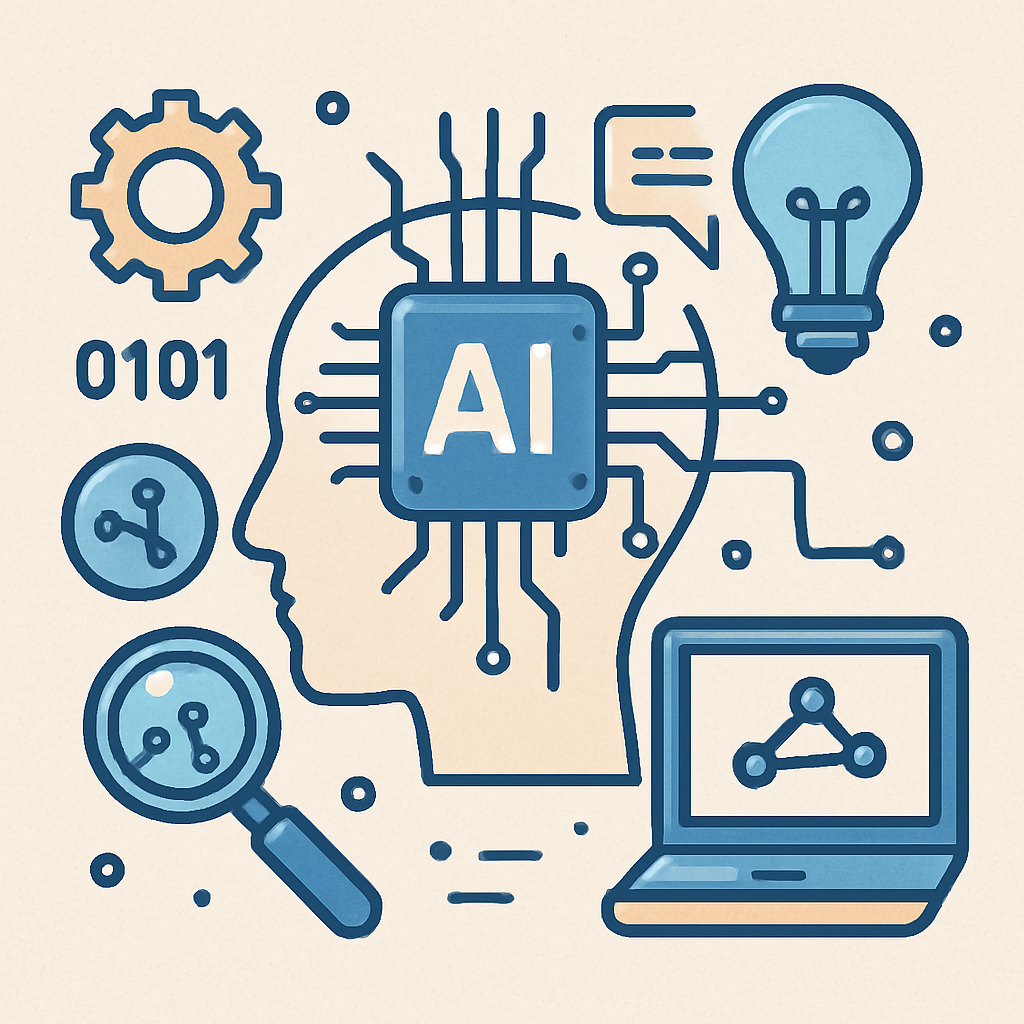
AI also involves the use of machine learning, where systems are trained on large datasets. These systems identify patterns and make decisions with minimal human intervention.
Understanding AI provides insights into how it transforms industries and impacts our everyday lives. From improved efficiencies to new innovations, the AI overview captures its dynamic, evolving nature in technology. By grasping these fundamentals, we equip ourselves for a future enriched by AI advancements.
A Brief History of AI
The history of AI is rich and expansive, stretching back to ancient dreams. Myths of artificial beings with intelligence have long existed, reflecting our quest to create machines that think like us.
AI’s modern journey began in the mid-20th century. In 1956, John McCarthy organized the Dartmouth Conference, where the term “artificial intelligence” was coined. This event is viewed as the birth of AI as an academic field.
Throughout the decades, AI research has seen periods of rapid progress and periods of stagnation known as “AI winters.” These “winters” were marked by reduced funding and waning interest due to unmet expectations.
Significant milestones include the development of early AI programs capable of playing chess and solving algebraic problems. These achievements demonstrated AI’s potential, sparking further research and investment.
Some key events in AI history are:
- 1950s-60s: Birth of AI and early programs
- 1970s-80s: Expert systems rise
- 1990s: AI wins at chess
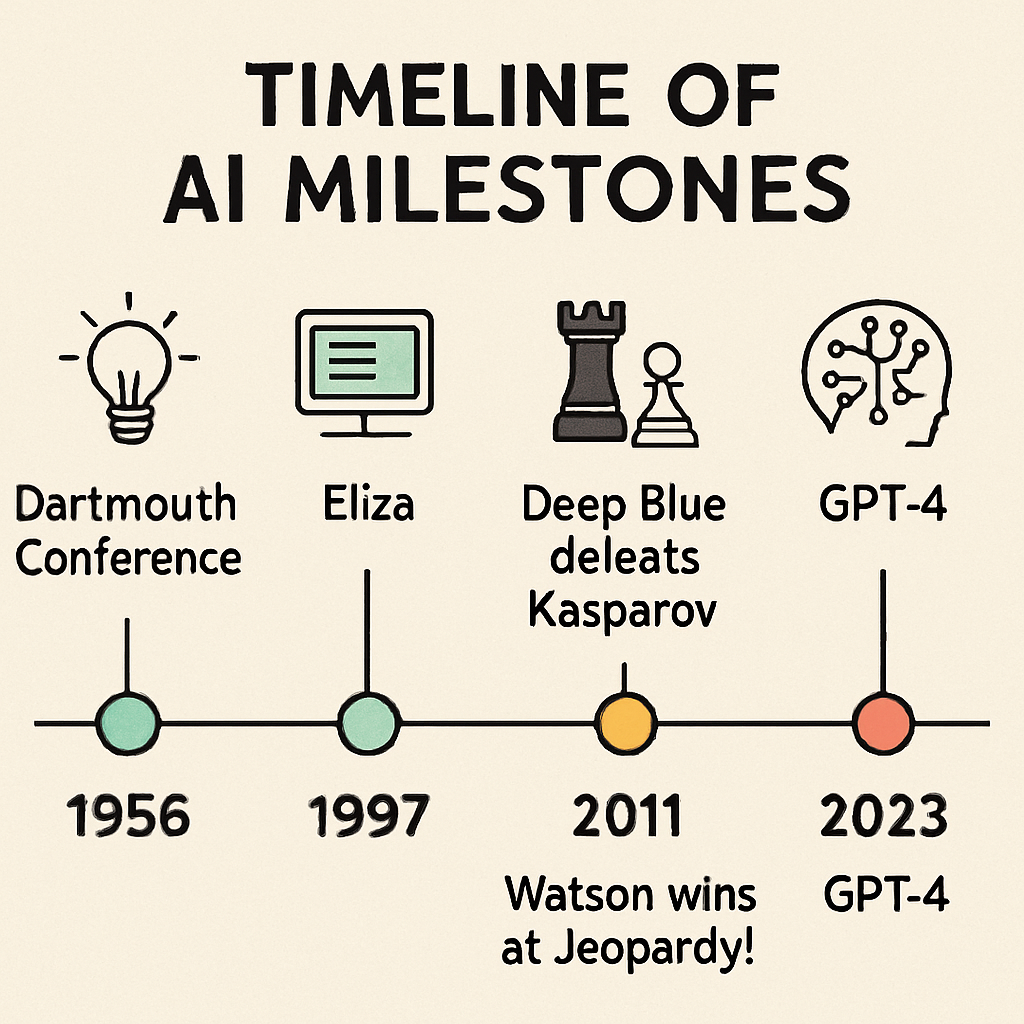
In recent years, advancements in computing power and data have fueled AI’s resurgence. Today’s AI technologies are more powerful, shaping industries and daily life. This historical journey illustrates AI’s evolution from concept to reality, highlighting both challenges and breakthroughs. Understanding AI’s history enriches our appreciation of its present capabilities and future potential.
Key Concepts and Types of AI
Understanding AI begins with its foundational concepts. At its core, AI involves creating systems that simulate human thought processes. This includes reasoning, learning, and even perception.
AI can be classified into several categories based on its capabilities and functions. The main types include narrow AI, general AI, and superintelligent AI. Each serves unique purposes and offers different potential.
Narrow AI, also known as weak AI, is designed for specific tasks. For example, systems that recognize faces or help with internet searches fall under this category. These systems excel in a focused area but cannot perform beyond their specialization.
General AI, or strong AI, is theoretical at this point. It refers to machines that possess the ability to understand and reason about the world, much like a human. The potential of achieving general AI remains a significant area of research and debate.
Superintelligent AI surpasses human intelligence and capabilities. Though still in the realm of science fiction, its implications are far-reaching. Superintelligent AI could revolutionize fields beyond our current understanding.
Key concepts to grasp in AI include:
- Machine Learning: Algorithms that enable systems to learn and adapt.
- Deep Learning: A subset of machine learning with layered neural networks.
AI also involves technologies such as natural language processing and robotics. These are critical in enabling machines to interact with humans effectively. Each concept builds upon the last, creating a complex and dynamic field.

by Zach M (https://unsplash.com/@zachmmalin)
Together, these concepts form the basis of AI technology, driving innovation and application across various industries. Understanding them is essential for navigating AI’s present and future landscapes.
Narrow AI vs. General AI vs. Superintelligent AI
AI’s types are often compared to understand their distinctions. Narrow AI, or weak AI, focuses on single tasks. It excels in specific domains but has limited scope beyond those tasks.
General AI, in contrast, represents a broader capability. It aims to perform any intellectual task a human can do. This includes reasoning, problem-solving, and adapting to new situations.
Superintelligent AI is a hypothetical future prospect. It envisions machines outperforming human intelligence across all fields. This stage raises numerous ethical and practical questions.
A simple list to differentiate these AI types includes:
- Narrow AI: Task-specific, excels in focused areas.
- General AI: Human-like intelligence, versatile and adaptive.
- Superintelligent AI: Surpasses human capabilities, yet to be achieved.
Each type reflects different stages and ambitions in AI research. Understanding these helps in comprehending AI’s potential, limitations, and the future it may lead us to.
Core Technologies: Machine Learning, Deep Learning, and Neural Networks
Machine learning is a significant subset of artificial intelligence. It involves teaching machines to make decisions based on data. Algorithms learn from input data, identifying patterns and making predictions.
Deep learning takes machine learning further with complex neural networks. These networks mimic the human brain’s workings, with interconnected nodes akin to neurons. Deep learning excels in processing vast amounts of data efficiently.
Neural networks are the backbone of deep learning. Layers of nodes process inputs and pass them through the network, refining results. Each layer extracts specific features, improving accuracy with each pass.
Core technologies in AI include:
- Machine Learning: Data-driven algorithms, capable of learning patterns.
- Deep Learning: Advanced neural networks, handling large datasets.
In practice, these technologies power many AI applications. They underpin systems like image recognition, natural language processing, and autonomous vehicles. Their adaptive nature allows AI to evolve continually.
A list of benefits from these technologies includes:
- Efficiency: Reduces processing time, making complex calculations quicker.
- Scalability: Handles large-scale data with ease, adapting over time.

by Steve A Johnson (https://unsplash.com/@steve_j)
The innovation in these core technologies is transforming industries worldwide. They pave the way for smarter systems, enhancing capabilities beyond traditional computing. As these technologies advance, their role in AI continues to grow, shaping the future landscape of technology.
Essential AI Terminology Explained
Understanding AI starts with familiarizing yourself with its terminology. These terms form the foundation of AI knowledge. Each has unique implications in the field.
An algorithm is a set of rules followed in problem-solving operations. In AI, algorithms drive machine behavior. They determine how machines learn and interpret data.
Training data is the information used to teach AI systems. Large, diverse datasets improve accuracy. The more data available, the better the system’s predictions.
Another key term is natural language processing (NLP). This technology allows machines to understand and respond to human language. NLP plays a critical role in voice-activated assistants.
Important AI terms to know include:
- Algorithm: Problem-solving operations guide.
- Training Data: Data used to train AI.
- Natural Language Processing (NLP): Enables machine comprehension of human language.
These concepts are essential to grasping AI basics. They facilitate understanding of AI’s operational mechanisms and are crucial to engaging with the technology effectively. Mastery of AI terminology enhances both application and development within the field.
How AI Works: Data, Algorithms, and Training
AI systems rely on a few key components to function effectively. Data, algorithms, and training are at the heart of these systems. Understanding their roles is critical for grasping AI basics.
Data is the foundation of AI, providing the raw material for learning. Without data, AI systems cannot generate insights or make decisions. High-quality, diverse datasets improve system performance.
Algorithms process this data, applying mathematical procedures to interpret it. These algorithms identify patterns and connections. They are essential for converting raw data into useful information.
Training is the process of teaching AI systems to learn from data. During training, algorithms adjust to improve accuracy. This process involves iterative cycles, refining the AI’s predictive power.
An overview of how AI works involves:
- Collecting relevant data
- Applying algorithms for analysis
- Training systems for improved accuracy
Together, these components enable AI systems to simulate intelligent behavior. They work in harmony to allow machines to learn and adapt over time.

by Mohamed Nohassi (https://unsplash.com/@coopery)
Major Applications of AI Today
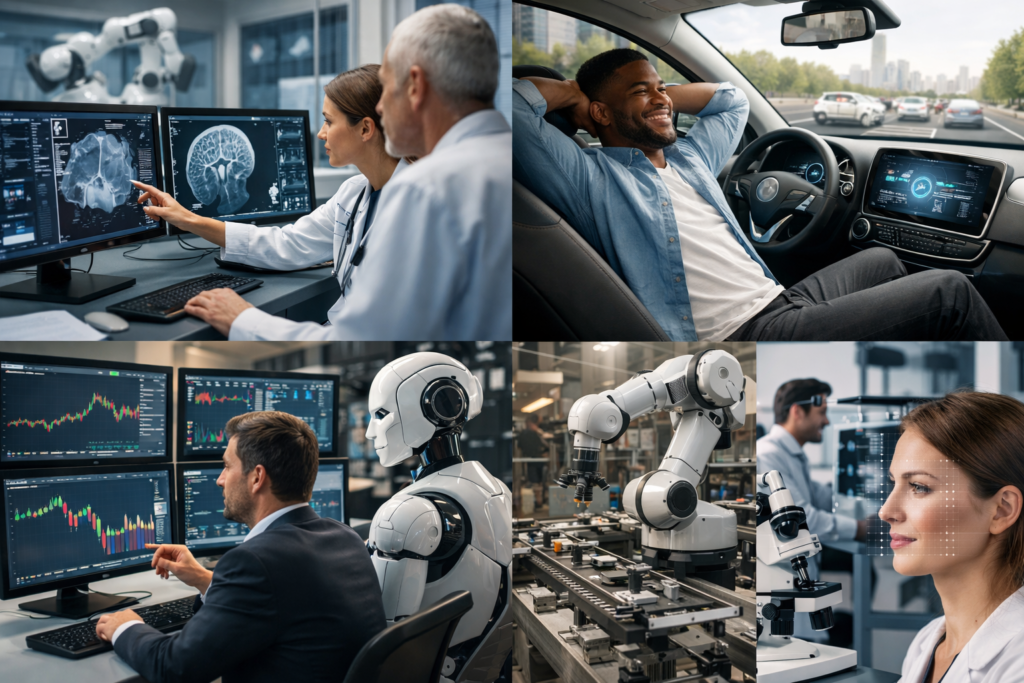
AI technology is revolutionizing numerous industries, reshaping the way we live and work. From healthcare to finance, its impact is profound.
In healthcare, AI aids in diagnostic accuracy and personalized treatment. It processes medical data quickly and detects patterns that humans might overlook.
Finance sectors utilize AI for fraud detection and risk assessment. Algorithms analyze transactions in real-time, flagging suspicious activities for further review.
In the automotive industry, AI powers autonomous vehicles. It processes sensor data to navigate roads and recognize obstacles effectively.
AI in entertainment personalizes content recommendations. Streaming services use algorithms to analyze viewing patterns, suggesting shows that match preferences.
Furthermore, AI plays a critical role in natural language processing. Virtual assistants like Siri and Alexa rely on this technology to understand and respond to voice commands.
A comprehensive overview of AI applications includes:
- Healthcare: diagnostics, personalized medicine
- Finance: fraud detection, risk management
- Automotive: autonomous driving, traffic pattern analysis
- Entertainment: content personalization, user engagement
- Communication: virtual assistants, speech recognition
AI continues to drive advancements across various sectors, shaping future possibilities.
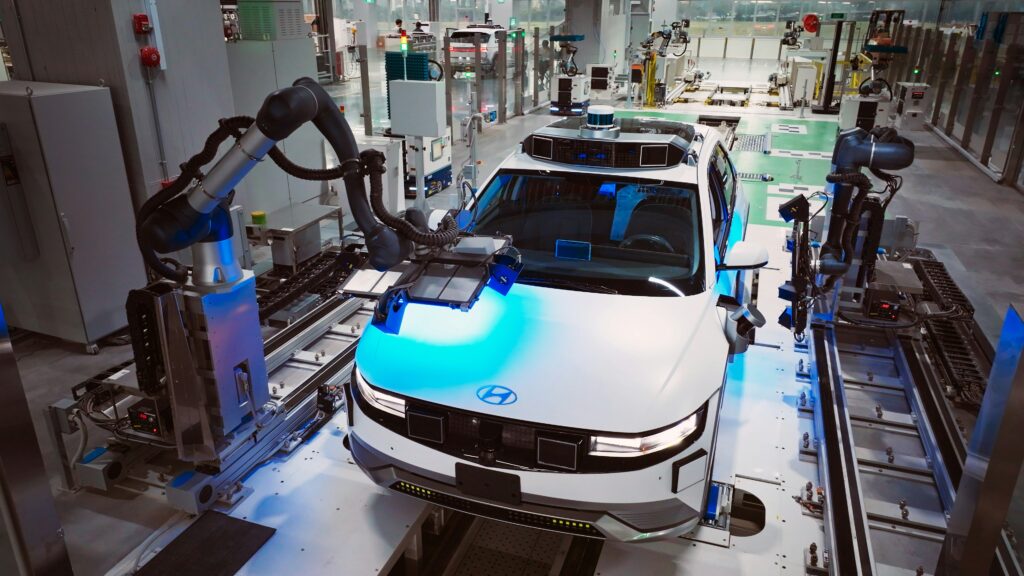
by Hyundai Motor Group (https://unsplash.com/@hyundaimotorgroup)
Benefits and Opportunities of AI
AI technology offers tremendous benefits across various domains. It enhances efficiency by automating repetitive tasks, freeing human resources for creative and complex projects.
Additionally, AI provides data-driven insights that improve decision-making. Businesses can leverage predictive analytics to forecast trends and tailor strategies accordingly.
Furthermore, AI opens new avenues for innovation, fostering the development of cutting-edge technologies and solutions. It expands the frontier of possibilities, driving economic growth.
Some key benefits of AI include:
- Increased efficiency and productivity
- Improved decision-making with predictive analytics
- Innovation opportunities in multiple sectors
These opportunities offer transformative potential, driving progress in the digital age.
Challenges, Risks, and Ethical Considerations
The rise of AI technology brings significant challenges and risks that need addressing. One major concern is data privacy, with AI systems often requiring large volumes of personal information.
Bias in AI algorithms poses another issue, as systems can inherit prejudices from their training data. This can lead to unfair or unethical outcomes in decision-making.
The impact of AI on employment also presents concerns, with potential job displacement due to automation. Yet, it can also create new roles requiring AI proficiency.
Ethical considerations are crucial for AI development and deployment. Developers must prioritize transparency, accountability, and fairness in AI systems.
A few primary challenges and risks include:
- Data privacy and security concerns
- Algorithmic bias and ethical implications
- Employment shifts due to automation
Efforts to address these challenges can foster responsible AI growth. Balancing technological advancement with ethical practices ensures AI benefits society as a whole.

by 愚木混株 Yumu (https://unsplash.com/@cdd20)
The Future of AI: Trends and Predictions
AI is poised to transform numerous sectors with ongoing advancements. Exciting trends include integration with quantum computing, potentially revolutionizing problem-solving capabilities.
AI-human collaboration will also grow, enhancing productivity and innovation across industries. This cooperation will refine processes and boost decision-making capabilities.
Future predictions indicate AI’s role in driving economic growth. Key areas expected to see notable evolution include:
- Enhanced AI-human collaboration
- Advancements in AI-driven healthcare and finance
- Integration with quantum computing
Keeping an eye on these trends can help organizations and individuals adapt and flourish. Understanding potential shifts in AI applications is essential for navigating a constantly evolving digital landscape.
by Hitesh Choudhary (https://unsplash.com/@hiteshchoudhary)
Getting Started with AI: Learning Resources and Next Steps
AI offers numerous learning opportunities for beginners and enthusiasts. To start, explore online courses and tutorials that introduce AI basics and concepts.
Many universities and platforms provide accessible resources. By joining AI communities, you can engage with like-minded individuals and professionals.
Here are some steps to consider for your AI journey:
- Enroll in online AI courses
- Read introductory AI books and articles
- Participate in AI forums and discussion groups
Embarking on this path equips you with essential skills. These resources prepare you for an exciting future in AI.